A pneumatic control valve is not a simple commodity product. For many industrial projects, it is the final control element that directly affects flow, pressure, temperature, liquid level, safety and process stability. A wrong valve selection may cause unstable control, leakage, actuator failure, excessive pressure drop, cavitation, noise or even production loss.
After several years working as an international sales engineer for pneumatic control valves, I have found that this industry is very different from ordinary valve export. Customers are not only buying a valve body. They are buying a complete control solution that includes valve sizing, trim selection, actuator matching, positioner configuration, control signal confirmation, installation conditions and after-sales technical support.
This article shares practical industry observations from the perspective of a Chinese pneumatic control valve manufacturer, with a special focus on why China's control valve manufacturing is already mature, why Chinese brands still have a low direct presence in many international projects, and why manufacturers such as Jianeng Valve are becoming more ready to serve global buyers directly.
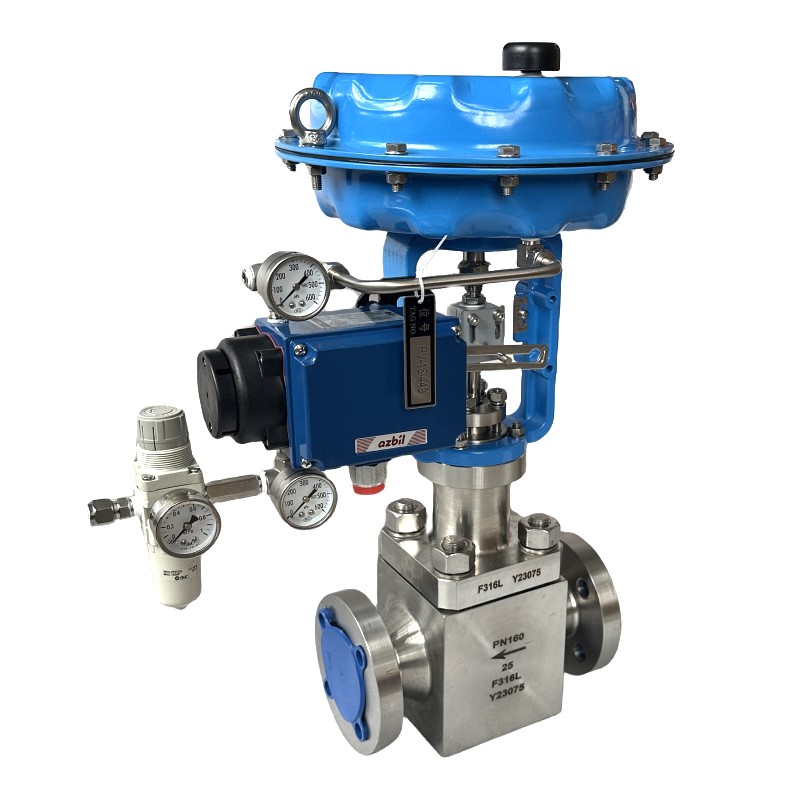
What Is a Pneumatic Control Valve?
A pneumatic control valve is a valve assembly operated by compressed air. It normally includes a valve body, internal trim, pneumatic actuator, valve positioner and accessories such as solenoid valves, air filter regulators, limit switches or feedback devices.
The valve receives a control signal from a control system, such as a DCS or PLC. The positioner then adjusts the actuator air pressure so the valve stem or shaft moves to the required position. By changing the valve opening, the system can regulate flow, pressure, temperature or level.
Common pneumatic control valve types include:
- Single-seat globe control valves
- Cage-guided control valves
- Balanced and unbalanced control valves
- Pneumatic butterfly control valves
- V-notch ball control valves
- Eccentric rotary control valves
- Angle control valves
- Three-way control valves
- Self-operated and special severe-service control valves
Compared with manual valves, pneumatic control valves require more engineering work before production. They must be selected according to the actual process conditions, not only pipe size and pressure class.
A Brief History of Pneumatic Control Valves in China
Modern control valve technology developed first in industrial automation markets such as Europe, the United States and Japan. As process industries expanded in oil and gas, petrochemicals, power generation, metallurgy, water treatment and chemicals, control valves became a key part of industrial automation systems.
In China, pneumatic control valves began to develop rapidly after foreign process control technology entered the country. During the 1980s and 1990s, many Chinese control valve manufacturers learned from imported designs and localized foreign technology. One of the most influential platforms was the Japanese CV3000-style control valve series.
The CV3000 control valve platform had a strong impact on China's control valve industry. Some early Chinese manufacturers introduced, licensed or absorbed Japanese control valve technology and then developed domestic product families based on local manufacturing capability. For example, public information shows that Chongqing Chuanyi Control Valve introduced Japanese CV3000-related design and manufacturing technology in 1992. Wuzhong Instrument, another representative Chinese control valve company, was established in 1959 and became one of the leading enterprises in China's control valve industry.
This history matters because it explains why many Chinese pneumatic control valve factories today have mature product structures, similar valve families and well-established manufacturing processes. The technology is no longer new in China. After decades of localization, many domestic manufacturers can produce single-seat valves, cage valves, low-noise valves, high-pressure valves, V-ball control valves and pneumatic actuator packages for a wide range of industrial applications.
The Global Market Is Growing, But Recognition Is Uneven
The global control valve market is still growing. IMARC Group estimated that the global control valves market reached about USD 9.7 billion in 2024 and forecast steady growth through 2033. Growth is driven by industrial automation, energy efficiency, new power and chemical projects, water and wastewater treatment, and the digitalization of process control.
However, market growth does not mean that all manufacturers have equal access to global buyers. In many international projects, especially in Europe, North America, the Middle East and high-end process industries, several well-known brands still dominate the qualified vendor lists. Names such as Fisher, Masoneilan, SAMSON, Motoyama, Flowserve, Valmet/Neles, KOSO and other established brands carry strong recognition.
For decades, these brands have built trust through project references, local service networks, engineering documentation and long-term relationships with EPC companies and end users. As a result, many international customers are familiar with Western and Japanese brands but may not even know that Chinese manufacturers can produce pneumatic control valves.
This is one of the biggest challenges for Chinese control valve exporters. The product capability exists, but the international brand awareness is still limited.
China's Pneumatic Control Valve Manufacturing Is Mature
From a manufacturing perspective, China's pneumatic control valve industry has made significant progress. Many factories can now produce high-quality control valve bodies, trims, pneumatic actuators and accessories. CNC machining, material inspection, pressure testing, flow characteristic design, positioner matching and quality management systems are much more mature than they were 20 years ago.
For standard and medium-demand applications, Chinese pneumatic control valves can often provide a strong balance of performance and cost. This is especially true in industries such as:
- Water treatment
- Chemical processing
- Petrochemical auxiliary systems
- Palm oil and food processing
- Power plant auxiliary systems
- Mining and metallurgy
- Pulp and paper
- HVAC and utility systems
- General industrial automation
Chinese manufacturers are also becoming more experienced with international standards, documentation and export requirements. Many factories can provide ISO certificates, CE-related documents, pressure test reports, material certificates, product drawings, datasheets, packing lists and export documents.
The gap is no longer only about manufacturing. The bigger gap is often communication, project support and overseas trust.
Why Direct Export From Chinese Manufacturers Is Still Difficult
Although China's control valve manufacturing is mature, direct export from factories to overseas end users is still not very common. From my observation, there are several reasons.
First, brand recognition is still weak. Many end users trust familiar brands because they appear in old project specifications and approved vendor lists. When a plant has used Fisher or Masoneilan for years, switching to a Chinese brand requires confidence, technical proof and a clear commercial reason.
Second, pneumatic control valves require complex technical communication. A buyer cannot simply say, "I need a DN50 pneumatic control valve." The manufacturer needs to know many details before selecting the valve.
Important parameters include:
- Valve function and control objective
- Installation location and local environment
- Medium name and composition
- Operating temperature
- Inlet and outlet pressure
- Minimum, normal and maximum flow rate
- Required pressure drop
- Pipe size and connection standard
- Flow characteristic
- Leakage class
- Actuator action and fail position
- Air supply pressure
- Positioner type and control signal
- DCS or PLC connection requirements
- Explosion-proof or hazardous area requirements
- Material, corrosion and erosion conditions
Third, many Chinese factories have limited English technical communication ability. The production and engineering teams may understand valves very well, but they may not be comfortable explaining Cv calculation, actuator selection, fail-close logic, 4-20 mA control signals, pneumatic accessories or DCS integration in English.
Fourth, many export orders therefore go through trading companies or EPC contractors. Trading companies may speak English well, but many of them do not deeply understand control valve engineering. EPC companies may know the project requirements, but they usually purchase valves as part of a larger package rather than building a direct relationship between the manufacturer and the final end user.
This creates a gap: factories have the technical capability, trading companies have the language capability, but global buyers need both in one place.
The Export Gap: Trading Companies, EPC Projects and End Users
In many overseas projects, Chinese pneumatic control valves are exported indirectly. A common path is:
- An overseas project is designed by an engineering company.
- A Chinese EPC or contractor wins part of the project.
- The EPC buys control valves from Chinese manufacturers.
- The valves are shipped to the foreign project site.
- The end user may never communicate directly with the manufacturer.
This model has helped many Chinese products enter international projects. However, it also has limitations. The end user may not know who made the valve. The manufacturer may not receive detailed feedback from the site. If a technical issue appears, communication can pass through multiple layers.
For standard project procurement, this may still work. But for pneumatic control valves, direct technical communication is often better. A control valve is a selected product, not a shelf item. When the manufacturer can talk directly with the user or project engineer, the selection becomes more accurate and the final performance is usually better.
Jianeng Valve: From Domestic Manufacturing to Global Customers
Jianeng Valve is an example of a Chinese manufacturer moving from domestic manufacturing strength toward direct international service. The company has been involved in pneumatic control valves since 1997 and has built experience in control valves, butterfly valves, ball valves and related valve products.
Since 2023, Jianeng Valve has put more effort into foreign trade and direct communication with overseas customers. During this process, we have contacted customers from the Middle East, Central Asia, South America and Southeast Asia. These markets are often more open to Chinese industrial products because buyers care about cost performance, response speed and practical technical support.
For pneumatic control valve inquiries, Jianeng Valve does not only quote a model number. The process usually starts with understanding the customer's real application. We guide the customer to explain the process, the medium, the control purpose and the pain point. Then we check the technical parameters step by step and provide a suitable valve solution.
The goal is to avoid selection mistakes before production. A wrong control valve may look correct on paper but fail in service because of oversizing, wrong flow characteristic, wrong actuator action, unsuitable trim material or incorrect signal configuration. Through several rounds of communication, the selection can become much more accurate.
How a Professional Manufacturer Handles a Pneumatic Control Valve Inquiry
For global buyers, a professional pneumatic control valve supplier should help organize the inquiry rather than simply waiting for a perfect datasheet.
A typical technical communication process may include:
- Confirm the process medium and whether it is liquid, gas, steam or slurry
- Confirm minimum, normal and maximum flow conditions
- Check inlet pressure, outlet pressure and pressure drop
- Confirm temperature and material compatibility
- Select valve type, such as single-seat, cage-guided, butterfly, V-ball or eccentric rotary
- Calculate or check Cv value
- Confirm leakage class and shutoff requirement
- Select actuator size and fail action
- Confirm air supply pressure
- Select positioner, solenoid valve, air filter regulator and limit switch if needed
- Confirm signal type, such as 4-20 mA, pneumatic signal, HART or on/off control
- Provide drawing, datasheet and quotation
This process is especially useful for buyers who do not have a large internal engineering team. Instead of forcing the customer to know everything at the beginning, the manufacturer helps lead the technical conversation.
Why Chinese Manufacturers Are Ready for More Global Buyers
Chinese pneumatic control valve manufacturers are ready for more global buyers for several reasons.
First, manufacturing experience is already mature. Decades of domestic industrial development have created a strong base of control valve manufacturing, machining, assembly and testing capability.
Second, cost performance is strong. Chinese products are often more affordable than Western or Japanese brands while still meeting the needs of many industrial applications. For markets where project budget matters, this is a major advantage.
Third, many emerging markets are expanding industrial infrastructure. The Middle East, Central Asia, South America, Southeast Asia and parts of Africa continue to develop energy, water, chemical, mining, food processing and industrial automation projects. These markets need reliable control valves but may not always require the highest-priced global brands.
Fourth, some Chinese manufacturers are building international sales and engineering communication teams. This directly addresses the old weakness of the industry: factories understood products but could not communicate well with overseas users.
Fifth, buyers are becoming more open to alternative suppliers. Many global buyers now want to reduce procurement cost, shorten lead time and diversify their supply chain. If a Chinese manufacturer can provide technical clarity, quality documentation and responsive support, it has a real chance to win trust.
The Reality of Western and High-End Markets
It is also important to be realistic. Europe and North America are difficult markets for Chinese pneumatic control valve brands. These markets have strong local suppliers, strict standards, mature distributor networks and conservative end users. Many plants already have long-term relationships with established brands.
In high-end severe-service applications, global brands still have strong advantages in project references, advanced trim design, local service, diagnostics and lifecycle support. Chinese manufacturers should not underestimate this.
However, this does not mean Chinese brands have no opportunity. The best strategy is not to compete everywhere immediately. It is better to start with suitable industries and regions where the application matches the manufacturer's capability and where customers value cost performance and direct support.
Overview of China's Pneumatic Control Valve Industry
China has many pneumatic control valve manufacturers. Some are large and well-known in the domestic market, while others are smaller specialized factories. Companies such as Wuzhong Instrument and Chongqing Chuanyi are among the earlier and more representative enterprises in China's control valve industry.
These older companies have strong domestic reputations and project experience. However, many of them still focus mainly on the Chinese market or participate in overseas projects through EPC channels. They may not always communicate directly with international end users in the same way an export-focused manufacturer does.
At the same time, a new type of Chinese control valve manufacturer is emerging: technically capable, medium-sized or large enough to maintain quality systems, but flexible enough to serve overseas customers directly. Jianeng Valve belongs to this more export-oriented direction.
For global buyers, this type of manufacturer can be attractive because:
- The company has real manufacturing capability
- The product line is suitable for industrial control applications
- Quality systems and certificates are relatively complete
- Pricing is more competitive than many global brands
- Communication is more direct than through trading companies
- Technical support can be provided during inquiry and selection
- The supplier is motivated to build long-term export relationships
What Global Buyers Should Look For
When choosing a Chinese pneumatic control valve manufacturer, global buyers should not judge only by price. A low price is meaningless if the valve is selected incorrectly.
Buyers should check whether the supplier can provide:
- Clear technical datasheets
- Valve drawings
- Cv or Kv calculation support
- Actuator and positioner matching
- Material and pressure test documents
- Export packaging
- Communication in English
- Fast response to technical questions
- Understanding of DCS, PLC and control signal requirements
- Application experience in similar industries
A good supplier should ask many questions. That is not a problem; it is a sign of responsibility. For pneumatic control valves, careful questions before production can prevent expensive problems after installation.
Final Thoughts
The pneumatic control valve industry is changing. Global demand for process automation is still growing, and China has already developed mature manufacturing capability. The challenge for Chinese manufacturers is no longer only how to produce the valve. The bigger challenge is how to make global buyers understand, trust and correctly use Chinese pneumatic control valves.
For many years, international customers mainly knew brands such as Fisher, Masoneilan, SAMSON and Motoyama. These brands deserve their reputation, but they are not the only possible solution for every project. Chinese manufacturers now have the experience, cost advantage and product capability to serve more global buyers, especially in emerging markets and standard industrial applications.
Jianeng Valve's experience shows one direction for the industry. Since entering foreign trade more actively in 2023, the company has learned that overseas customers do not only need a cheaper valve. They need a manufacturer that can understand the process, guide the technical discussion, provide complete parameters and reduce selection risk.
FAQ
Why are pneumatic control valves difficult to export directly?
They require detailed technical communication, including medium, pressure, temperature, flow rate, Cv, actuator action, positioner signal and control system requirements. Many buyers and trading companies do not have enough technical knowledge to complete this process easily.
Are Chinese pneumatic control valve manufacturers mature?
Yes. Many Chinese manufacturers have decades of control valve manufacturing experience and can produce single-seat, cage-guided, butterfly, V-ball and other pneumatic control valves. The bigger challenge is often international brand recognition and technical communication.
Which global brands dominate the control valve market?
Well-known global control valve brands include Fisher, Masoneilan, SAMSON, Motoyama, Flowserve, Valmet/Neles and KOSO. These brands have strong project references and high recognition in many international markets.
Why source pneumatic control valves from China?
Chinese manufacturers can offer strong cost performance, flexible production, mature product structures and improving technical support. For many standard industrial applications, they can be a practical alternative to higher-cost global brands.
What should buyers provide before asking for a quotation?
Buyers should provide the medium, flow rate, inlet and outlet pressure, temperature, pipe size, connection standard, control purpose, air supply pressure, required fail position and control signal. If these are not available, a professional supplier should help guide the inquiry.
Need Help Selecting Pneumatic Control Valves?
JIANENG Valve supports global buyers with control valve sizing, pneumatic actuator matching, positioner configuration and complete technical documentation.
Contact Our Technical Team