Control valves are essential components in industrial automation. They regulate flow, pressure, temperature and liquid level by changing the opening of the valve according to a signal from a controller. In chemical plants, refineries, power stations, water treatment systems, HVAC networks and process skids, a well-selected control valve helps the system run safely, efficiently and consistently.
Unlike simple on/off valves, control valves must handle continuous or frequent modulation. This means the valve body, trim, actuator and positioner must work together to provide stable control over a wide operating range. The wrong valve type can cause poor control accuracy, excessive pressure drop, cavitation, flashing, noise, vibration, erosion or premature seat damage.
The most common control valve types used in industrial applications include globe control valves, cage guided control valves, eccentric butterfly valves, V-ball valves and eccentric rotary valves. Each design has its own strengths. Globe control valves are widely used for precise throttling. Eccentric butterfly valves can regulate large flow with a compact body. V-ball valves offer high capacity and good rangeability. Eccentric rotary valves are useful for difficult services where high capacity, tight shutoff and rotary motion are preferred.
This guide gives a practical overview of the major industrial control valve types and explains where each design is commonly used.
Main Control Valve Types at a Glance
| Control valve type | Motion type | Main strength | Common applications |
|---|---|---|---|
| Globe control valve | Linear | Precise throttling and stable control | Steam, water, gas, chemical process control |
| Single seat globe control valve | Linear | Tight shutoff and simple structure | Low to medium pressure drop, clean fluids |
| Cage guided control valve | Linear | Balanced trim, lower actuator force and better stability | Higher pressure drop, steam, gas, demanding process control |
| Eccentric butterfly control valve | Rotary | High flow capacity in compact size | Large water, air, gas and low-pressure process lines |
| V-ball control valve | Rotary | High capacity with good rangeability | Pulp, slurry, steam, gas, process fluids |
| Eccentric rotary valve | Rotary | Strong throttling performance and high shutoff capability | Difficult fluids, high capacity control, erosive or dirty media |
What Is a Control Valve?
A control valve is a final control element that changes the flow area inside a pipeline. A controller sends a signal to an actuator, and the actuator moves the valve plug, ball, disc or rotary segment. As the valve opening changes, the flow rate or pressure changes.
A complete control valve assembly usually includes:
- Valve body
- Internal trim, such as plug, seat, cage, ball or disc
- Actuator, such as pneumatic diaphragm, pneumatic piston or electric actuator
- Positioner for accurate valve travel control
- Accessories such as solenoid valves, limit switches, air filter regulators and feedback transmitters
Control valves may be used for simple flow control, pressure reduction, temperature regulation, level control, mixing, bypass service or process safety functions. Because they directly affect process stability, valve selection should be based on flow rate, pressure drop, medium, temperature, control range, leakage class, noise, cavitation risk and actuator requirements.
Globe Control Valves
Globe control valves are among the most common and important control valve types in industrial applications. They use linear motion: the actuator moves a plug up and down against a seat. By changing the plug position, the valve changes the flow area and regulates the process.
Globe control valves are valued for accurate throttling, stable control and broad trim options. They can be designed for many pressure classes, materials, flow characteristics and leakage requirements. Compared with rotary valves, globe valves usually have higher pressure drop, but they provide excellent control performance in demanding applications.
Typical globe control valve applications include:
- Steam pressure and flow control
- Boiler feedwater control
- Cooling water and process water regulation
- Gas pressure reduction
- Chemical dosing and flow control
- Heat exchanger temperature control
- Reactor feed control
- General process modulation
Common globe control valve body styles include straight-through, angle type and three-way designs. The trim may be selected for equal percentage, linear or quick opening flow characteristics depending on the control requirement.
Single Seat Globe Control Valve
A single seat globe control valve uses one plug and one seat. It is often called a single seated control valve. In many cases, this is an unbalanced seat design because the process pressure acts on the plug and creates an unbalanced force that the actuator must overcome.
Single seat globe control valves are widely used because they are simple, accurate and capable of good shutoff. With the right plug and seat design, they can achieve tight leakage performance. They are often selected for clean fluids and low to medium pressure drop applications.
Main advantages of single seat globe control valves:
- Good control accuracy
- Simple internal structure
- Tight shutoff capability
- Easy maintenance
- Good choice for small and medium sizes
- Suitable for many clean liquid, gas and steam services
Main limitations:
- Higher actuator force may be required under high pressure drop
- Not ideal for very large sizes with high differential pressure
- Unbalanced force can increase stem load and actuator size
- Seat and plug may wear faster in severe throttling service
Single seat globe control valves are a good choice when the system needs accurate modulation and reliable shutoff, but the pressure drop is not too high for the actuator and trim design.
Cage Type Globe Control Valve
A cage type control valve is a globe valve that uses a cylindrical cage around the plug. The cage guides the plug and shapes the flow path. It can also provide noise reduction, anti-cavitation performance, pressure drop staging and balanced trim design.
Cage guided valves are common in modern process plants because they offer stable plug movement and many trim options. The cage can be designed with slots, holes or special passages to control flow characteristics and reduce vibration.
In a balanced cage type control valve, pressure is balanced across the plug through holes or passages in the trim. This reduces the net force acting on the plug, so the actuator does not need to be as large as it would be for an unbalanced single seat design under the same pressure drop.
Main advantages of cage type control valves:
- Better plug guidance and stability
- Balanced trim options for lower actuator force
- Suitable for higher pressure drop applications
- Good noise and cavitation control with special cages
- Wide range of flow characteristics
- Useful for steam, gas and demanding liquid services
Main limitations:
- More complex internal structure
- Higher cost than simple single seat designs
- Small cage openings may clog in dirty or slurry service
- Maintenance may require more careful trim inspection
Cage type globe control valves are often selected for high pressure drop, high temperature, steam, gas compression, pressure letdown and applications where vibration, noise or cavitation must be controlled.
Balanced Seat vs Unbalanced Seat
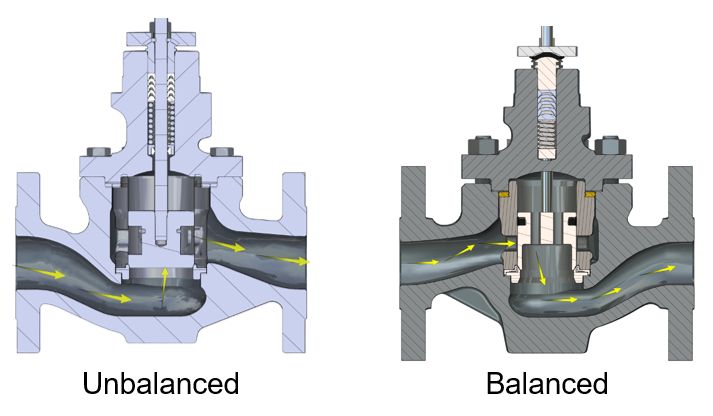
The difference between balanced and unbalanced control valve trim is important for actuator sizing and control stability.
In an unbalanced seat design, process pressure creates a force on the valve plug. The actuator must overcome this force to move and shut off the valve. Single seat globe control valves are often unbalanced. This design can provide tight shutoff, but it may require a larger actuator when pressure drop is high.
In a balanced seat or balanced trim design, pressure forces are reduced by using ports, balancing holes or special trim geometry. The actuator can move the plug with less force, even under higher differential pressure. Cage type control valves often use balanced trim.
Balanced trim is helpful when:
- Differential pressure is high
- Valve size is large
- Actuator size must be reduced
- Stable control is required under changing pressure
- Automation response must remain smooth
Unbalanced trim is useful when:
- Tight shutoff is important
- Valve size is smaller
- Pressure drop is moderate
- Simple maintenance is preferred
- The actuator can handle the required force
The best choice depends on pressure drop, leakage class, actuator type and control accuracy requirements.
Double Seat Globe Control Valve
Some globe control valves use a double seat design. In a double seated control valve, two plugs and two seats are arranged to help balance pressure forces. This reduces actuator load compared with a single unbalanced seat.
Double seat valves were historically common in applications requiring higher flow and lower actuator force. However, they often have higher leakage than single seat valves because both seats must seal at the same time. For applications requiring tight shutoff, single seat or modern balanced cage designs are often preferred.
Double seat globe control valves may be used for higher flow services, applications where leakage class is less strict, moderate pressure control, and older process systems or legacy valve replacement. Although still useful in some applications, many modern specifications now favor cage guided balanced globe valves for demanding service.
Three-Way Globe Control Valve
A three-way control valve has three ports and is used for mixing or diverting flow. In mixing service, two inlet streams are combined into one outlet. In diverting service, one inlet stream is split into two outlet paths.
Three-way globe control valves are common in heat exchanger temperature control, HVAC heating and cooling loops, boiler and chiller systems, process blending and bypass control. They are not the same as standard two-way throttling valves. The flow direction, pressure drop and control logic must be checked carefully during selection.
Angle Type Globe Control Valve
An angle control valve changes flow direction by 90 degrees inside the valve body. This design can reduce the number of pipe elbows and is useful in applications where pressure drop, flashing or erosive flow must be managed.
Angle type globe control valves are often used in boiler feedwater service, flashing liquid applications, high pressure drop liquid service, drain, letdown and blowdown lines, and applications with limited piping space. Because the flow path is different from a straight-through globe valve, angle valves may handle certain difficult services more effectively.
Eccentric Butterfly Control Valves
Butterfly valves are often thought of as isolation valves, but eccentric butterfly valves can also be used for control. An eccentric butterfly valve has a disc that rotates off-center from the shaft and seat. This reduces friction between the disc and seat during opening and closing, improving sealing performance and service life.
Common eccentric designs include double offset and triple offset butterfly valves. Double offset valves are often used for water, gas and general process service. Triple offset butterfly valves use a more advanced metal seat geometry and are suitable for higher temperature, higher pressure or tighter shutoff applications.
Eccentric butterfly control valves are useful when the system needs high flow capacity in a compact body. They are common in large pipe sizes where a globe valve would be too heavy, expensive or space-consuming.
Typical applications include:
- Cooling water control
- Chilled water and condenser water systems
- Air and gas flow control
- Large utility water lines
- Flue gas and process gas service
- Low to medium pressure process flow regulation
- Power plant and chemical plant auxiliary systems
Main advantages include compact and lightweight construction for large sizes, high flow capacity, lower cost than large globe valves, good shutoff with proper seat design and suitability for automation with quarter-turn actuators. Main limitations include lower control accuracy than globe valves in some conditions, instability at very small openings, the need to check cavitation, noise and velocity limits, and some flow obstruction from the disc.
V-Ball Control Valves
A V-ball control valve uses a ball with a V-shaped notch or characterized opening. As the ball rotates, the V-notch creates a controlled flow area. This gives the valve better throttling performance than a standard round-port ball valve.
V-ball valves combine high flow capacity with good rangeability. They are especially useful where a rotary valve is preferred but more accurate control is needed than a standard ball valve can provide.
Typical V-ball valve applications include:
- Pulp and paper process control
- Slurry and fiber-containing fluids
- Steam control
- Gas flow control
- Chemical process lines
- Wastewater and dirty fluid service
- High capacity liquid control
Main advantages include good rangeability, high flow capacity, strong shearing action for fibrous media, compact rotary design, lower pressure drop than many globe valves and good shutoff when paired with suitable seats. Main limitations include lower precision than globe valves in some low-flow applications, possible wear at the seat and ball edge in abrasive service, the importance of actuator and positioner selection, and the need to evaluate cavitation and noise under high pressure drop.
Eccentric Rotary Control Valves
An eccentric rotary valve uses a rotary plug or segment that moves eccentrically away from the seat as it opens. This design reduces seat friction and provides good control performance. In some markets, eccentric rotary valves may be confused with butterfly valves because both use rotary motion and can have a compact body. However, the internal geometry is different.
Eccentric rotary valves are sometimes described as rotary plug valves, segmented ball valves or eccentric plug control valves depending on the manufacturer and design. They are widely used in demanding industrial applications because they can handle high flow, relatively high pressure drop and difficult media.
Typical applications include:
- Dirty liquid control
- Slurry and erosive service
- Steam and gas control
- High capacity process control
- Chemical and petrochemical applications
- Pulp and paper systems
- Applications requiring tight shutoff with rotary motion
Main advantages include good throttling performance, lower friction due to eccentric motion, high flow capacity, good shutoff capability, suitability for dirty or erosive fluids with the right trim, and compact construction compared with many globe valve options. Main limitations include more specialized construction than standard butterfly or ball valves, critical trim selection, manufacturer-specific designs and the continued need for careful engineering in severe cavitation or flashing service.
Eccentric rotary valves are useful when a standard butterfly valve is not precise enough, a globe valve is too bulky or expensive, and the process needs a robust rotary control solution.
Other Industrial Control Valve Types
Although globe, butterfly, V-ball and eccentric rotary valves are among the most important industrial control valve types, other designs may also be used.
Diaphragm Control Valves
Diaphragm control valves use a flexible diaphragm to isolate the fluid from the actuator and bonnet area. They are used in corrosive, sanitary or slurry applications where clean separation and simple flow path are important.
Pinch Control Valves
Pinch valves use a flexible sleeve that is squeezed to regulate flow. They are suitable for abrasive slurry, wastewater, mining and solids-containing fluids because the valve body does not directly contact the medium.
Needle Control Valves
Needle valves provide fine control for low-flow applications. They are commonly used in instrumentation, sampling, laboratory and small process lines, but they are not usually used for large industrial flow control.
Axial Flow Control Valves
Axial flow control valves use an in-line flow path and are often selected for high-capacity gas applications where low noise and pressure recovery matter. They are more specialized and typically used in pipelines, compressor stations and gas processing facilities.
How to Choose the Right Control Valve Type
Control valve selection should start with process conditions, not valve preference. The correct valve type depends on what the valve must control and what problems it must avoid.
Important selection factors include:
- Fluid type, including liquid, gas, steam, slurry or mixed phase
- Flow rate range, including minimum, normal and maximum flow
- Inlet and outlet pressure
- Required pressure drop
- Temperature range
- Required control accuracy
- Shutoff leakage class
- Noise, cavitation and flashing risk
- Corrosion, erosion or solids content
- Pipe size and available installation space
- Manual, pneumatic or electric actuation
- Fail-open, fail-close or fail-in-place requirement
- Maintenance access and spare parts
For high-accuracy throttling, globe control valves are often the first choice. For high pressure drop or severe service, cage guided globe valves with special trim may be required. For large flow and large pipe size, eccentric butterfly valves may be more economical. For dirty or fibrous media, V-ball or eccentric rotary valves may perform better. For difficult process services, the final selection should include valve sizing and cavitation, noise and material checks.
Control Valve Type Selection by Application
| Application | Common valve type | Reason |
|---|---|---|
| Steam pressure control | Globe control valve or cage type control valve | Accurate throttling and pressure drop control |
| Boiler feedwater | Globe control valve or angle control valve | Stable control under demanding conditions |
| Cooling water control | Eccentric butterfly valve or globe valve | Large flow capacity and practical automation |
| Chemical dosing | Single seat globe control valve | Accurate small to medium flow control |
| Slurry or pulp control | V-ball valve or eccentric rotary valve | Better handling of dirty or fibrous media |
| Gas pressure reduction | Cage guided globe valve or axial flow valve | Noise control and stable pressure reduction |
| Large utility water line | Eccentric butterfly control valve | Compact, high capacity and cost-effective |
| High pressure drop liquid | Cage guided globe valve with anti-cavitation trim | Reduces cavitation and trim damage |
| HVAC mixing or bypass | Three-way globe control valve | Mixing or diverting function |
| Dirty process liquid | Eccentric rotary control valve | Robust rotary control and good shutoff |
Common Mistakes in Control Valve Selection
One common mistake is selecting a valve only by pipe size. Control valves must be sized by required flow and pressure drop. A valve that is too large may operate near the closed position and provide unstable control. A valve that is too small may restrict maximum flow.
Another mistake is using a standard on/off valve for control service. A standard ball valve or butterfly valve may throttle flow, but it may not provide stable or repeatable control. Control applications need suitable trim, actuator and positioner performance.
It is also risky to ignore cavitation, flashing and noise. These problems can damage the valve, create vibration and reduce service life. High pressure drop liquid service may require anti-cavitation trim. Gas and steam applications may require low-noise trim or pressure drop staging.
Finally, some buyers focus only on valve body material and forget the trim. The plug, seat, cage, stem and seals often experience the most severe flow conditions. Trim material should match the actual process conditions.
Final Thoughts
Industrial control valves come in many types because process conditions vary widely. Globe control valves provide precise and stable throttling. Single seat globe valves are simple and good for clean fluids with moderate pressure drop. Cage type globe valves support balanced trim, lower actuator force and severe service options. Eccentric butterfly valves offer compact high-capacity control for larger lines. V-ball valves provide strong rangeability and good performance with dirty or fibrous media. Eccentric rotary valves combine rotary motion, high capacity and robust throttling for demanding services.
The best control valve is not always the most expensive or the most common design. It is the valve that matches the required flow range, pressure drop, medium, temperature, leakage class and control accuracy. For critical industrial applications, proper sizing and trim selection are just as important as choosing the valve body type.
FAQ
What are the main types of control valves used in industrial applications?
The main industrial control valve types include globe control valves, single seat globe valves, cage type control valves, eccentric butterfly control valves, V-ball control valves, eccentric rotary valves, diaphragm valves, pinch valves, needle valves and axial flow control valves.
What is the most common type of control valve?
The globe control valve is one of the most common control valve types because it offers accurate throttling, stable control and many trim options for liquid, gas and steam applications.
What is the difference between single seat and cage type control valves?
A single seat control valve usually uses one plug and one seat, often with an unbalanced design. A cage type control valve uses a cage to guide the plug and can use balanced trim to reduce actuator force under higher pressure drop.
Can butterfly valves be used as control valves?
Yes. Eccentric butterfly valves, especially double offset and triple offset designs, can be used for flow regulation in many industrial applications. They are common in large pipe sizes where high flow capacity and compact installation are important.
What is a V-ball control valve used for?
A V-ball control valve is used for high-capacity throttling with good rangeability. It is common in pulp and paper, slurry, steam, gas, wastewater and process fluid applications where a standard ball valve is not suitable for accurate control.
Is an eccentric rotary valve the same as a butterfly valve?
No. Both are rotary valves, and they may look similar in some installations, but the internal design is different. An eccentric rotary valve uses an eccentric plug or segment that moves away from the seat, while a butterfly valve uses a rotating disc.
How do I choose the right control valve type?
Choose based on fluid type, flow range, pressure drop, temperature, required control accuracy, leakage class, cavitation or noise risk, pipe size, actuator requirements and maintenance conditions. For critical applications, professional valve sizing is recommended.
Need Help Selecting Industrial Control Valves?
JIANENG Valve supports global buyers with valve type selection, sizing, actuator matching, trim selection and complete technical documentation for industrial control applications.
Contact Our Technical Team