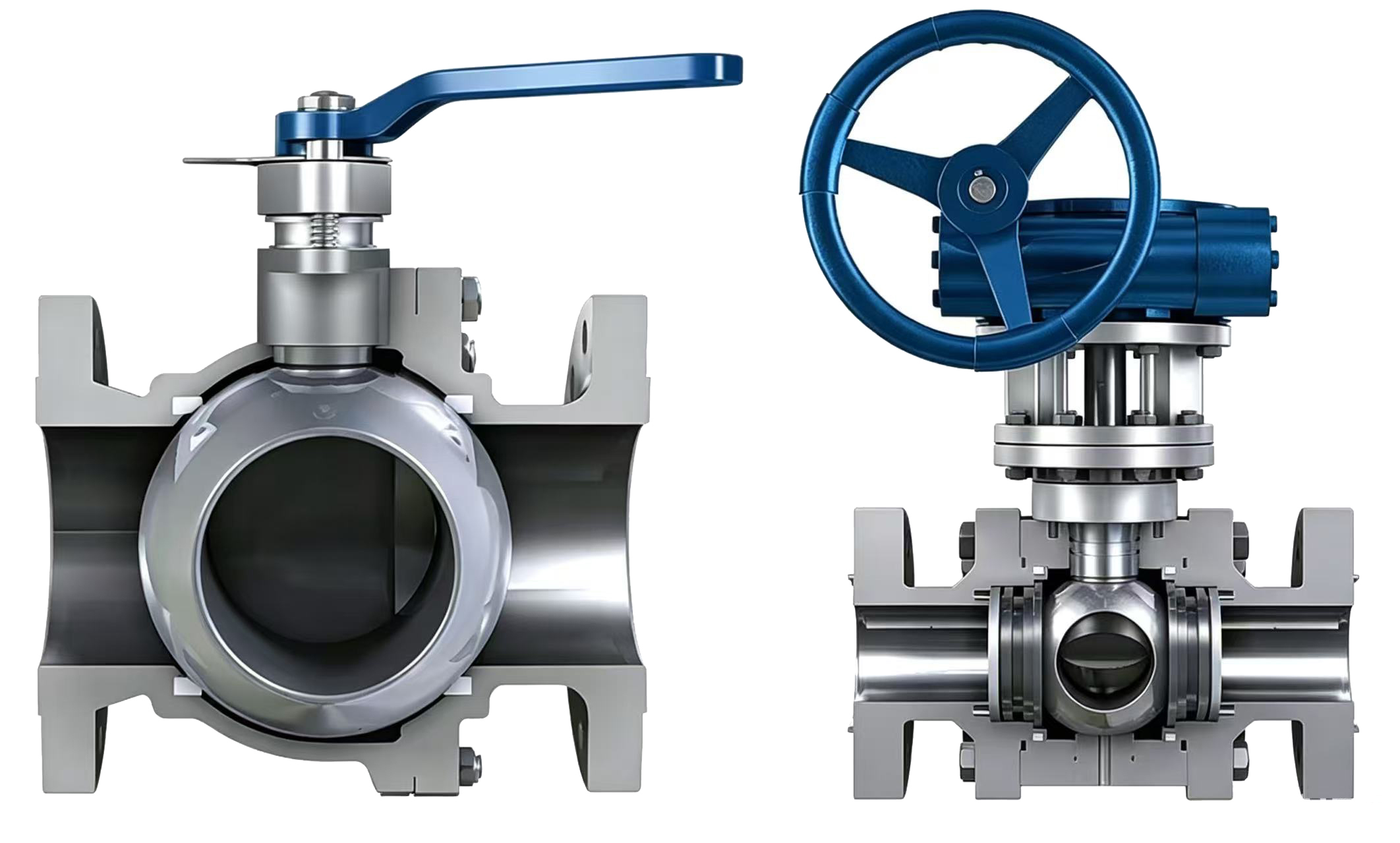
A trunnion mounted ball valve and a floating ball valve both use a quarter-turn ball to start or stop flow, but the ball support and sealing method are different. In a floating ball valve, line pressure pushes the ball slightly downstream against the seat. In a trunnion mounted ball valve, the ball is fixed by upper and lower supports, while the seats move toward the ball to create sealing.
This difference affects operating torque, pressure capability, size range, seat wear, maintenance, cost and suitability for API 6D pipeline service. Floating ball valves are usually selected for smaller sizes, moderate pressure and general industrial isolation. Trunnion mounted ball valves are preferred for larger lines, higher pressure, automation and critical pipeline shutoff.
This guide explains the main differences and gives practical selection advice for stainless steel ball valve applications.
Quick Answer
Choose a floating ball valve when the application is small to medium size, moderate pressure, compact, cost-sensitive and not too demanding. Choose a trunnion mounted ball valve when the application needs lower torque, larger size, higher pressure, automation, double block and bleed capability or reliable isolation in pipeline service.
In simple terms:
- Floating ball valve: the ball moves slightly to seal against the downstream seat.
- Trunnion mounted ball valve: the ball stays fixed, and the seats move to seal against the ball.
- Floating design is simpler and usually cheaper.
- Trunnion design is stronger for large, high-pressure or critical service.
- API 6D can apply to both designs when they are ordered for pipeline or piping valve service.
Trunnion Mounted vs Floating Ball Valves at a Glance
| Comparison factor | Floating ball valve | Trunnion mounted ball valve |
|---|---|---|
| Ball support | Ball floats slightly between the seats | Ball is supported by trunnions or shafts |
| Sealing principle | Pressure pushes ball into downstream seat | Spring-loaded or pressure-assisted seats seal against fixed ball |
| Common size range | Small to medium sizes | Medium to large sizes |
| Common pressure range | Low to medium pressure; high pressure possible in smaller sizes | Medium to high pressure, especially in larger sizes |
| Operating torque | Rises quickly with size and pressure | Lower and more stable in large or high-pressure service |
| Seat load | Higher downstream seat load under pressure | More controlled seat loading |
| Cost | Usually lower | Usually higher |
| Weight | Lighter and more compact | Heavier and more complex |
| Maintenance | Simple for small valves | More serviceable for critical pipeline valves |
| Typical use | Utilities, water, air, small process lines | Oil and gas, pipeline, refinery, high-pressure service |
What Is a Floating Ball Valve?
A floating ball valve is the most common ball valve design for small and medium industrial piping systems. The ball is held between two seats, but it is not fixed by a lower shaft. When the valve is closed and pressure enters from upstream, the ball moves slightly downstream. This movement presses the ball against the downstream seat and creates tight shutoff.
The design is popular because it is simple, compact and economical. A floating ball valve has fewer internal support components than a trunnion mounted design, so it is easier to manufacture and often easier to install in small sizes.
Floating ball valves are commonly used in:
- Water treatment systems
- General plant utility lines
- Chemical dosing skids
- Small stainless steel process lines
- Clean gas, air and sanitary service with suitable materials
The main limitation is that pressure increases the force between the ball and seat. As size and pressure rise, operating torque becomes higher and seat wear can increase. For this reason, floating ball valves are normally chosen for smaller and moderate-pressure service.
What Is a Trunnion Mounted Ball Valve?
A trunnion mounted ball valve uses mechanical support to hold the ball in a fixed position. The ball is supported at the top by the stem and at the bottom by a trunnion or shaft. Instead of the ball moving downstream for sealing, the seats move toward the ball.
In many trunnion mounted ball valves, the seats are spring-loaded and pressure-assisted. Springs provide initial sealing at low pressure, while line pressure helps energize the seat at higher pressure. Because the ball is supported, the valve can handle larger sizes and higher differential pressure with lower operating torque.
Trunnion mounted ball valves are commonly used in:
- Oil and gas transmission pipelines
- Natural gas processing plants
- Refineries and petrochemical plants
- Offshore and marine systems
- Large-diameter industrial pipelines
- Emergency shutdown and critical isolation service
A trunnion mounted ball valve is more complex and usually more expensive than a floating ball valve, but it provides better mechanical stability in demanding service.
Main Structural Difference
The biggest difference is how the ball is supported.
In a floating ball valve, the ball is not mechanically fixed at the bottom. It is held by the seats and stem, and it can shift slightly under pressure. This small movement is part of the sealing principle.
In a trunnion mounted ball valve, the ball rotates around a fixed axis. The trunnions absorb much of the mechanical load from line pressure, so the ball does not need to move downstream to seal. The seats are designed to move toward the ball instead.
This structural difference changes the valve's behavior under pressure. Floating ball valves become harder to operate as pressure and size increase. Trunnion mounted valves keep torque lower and more predictable in larger or higher-pressure applications.
Sealing Principle: Which Part Moves?
In a floating ball valve, the ball moves toward the seat. In a trunnion mounted ball valve, the seat moves toward the ball.
For floating ball valves, the line pressure helps create sealing force. At low pressure, the seat material and valve geometry provide the seal. At higher pressure, the ball is pushed harder into the downstream seat. This can improve shutoff, but it also increases friction and seat stress.
For trunnion mounted ball valves, the ball stays fixed. The seats are usually energized by springs and pressure. This design provides reliable sealing while reducing the friction that would occur if the full ball load were pushed into the downstream seat.
Many trunnion mounted designs can also be supplied with double block and bleed or double isolation and bleed functions when required by the project specification. These features are valuable in pipelines, custody transfer lines, fuel systems and other services where safe isolation and cavity venting are important.
Pressure, Size and Operating Torque
Floating ball valves can work very well in smaller sizes. However, as valve size increases, the pressure acting on the ball creates a much larger force against the downstream seat. This raises break torque and running torque.
Trunnion mounted ball valves are preferred when pressure, diameter or automation requirements increase. Because the ball is supported, the valve can remain operable under higher differential pressure. This makes actuator sizing more practical and reduces the risk that a manual operator or actuator will be unable to move the valve.
For automated valves, always check break torque, running torque, maximum differential pressure, actuator safety factor, seat limits, stem strength and gearbox requirements.
An undersized actuator may fail to close the valve under pressure. An oversized actuator may damage the stem, seats or stops if the torque is not controlled correctly.
Seat Wear and Service Life
Seat wear is another important difference.
In a floating ball valve, the downstream seat carries more load when the valve is closed under pressure. This is usually acceptable in clean, small and moderate-pressure service. In high-pressure or frequent-cycling service, the higher seat load may shorten seat life.
In a trunnion mounted ball valve, seat loading is more controlled because the ball is supported. This can improve service life in critical applications. Trunnion mounted valves may also include replaceable seats, cavity pressure relief, drain and vent connections, and emergency sealant injection depending on the design and specification.
For clean water or utility isolation, both designs can provide long service life when properly selected. For abrasive, dirty, high-cycle, high-pressure or safety-critical service, seat design and material selection become much more important.
API 6D Requirements for Both Ball Valve Types
API Specification 6D is widely used for pipeline and piping valves in oil, gas and related industrial service. When a floating or trunnion mounted ball valve is ordered to API 6D, the manufacturer must treat it as a pipeline valve, not only as a general-purpose shutoff valve.
API 6D addresses design, materials, manufacturing, assembly, inspection, testing, marking and documentation. For both floating and trunnion mounted ball valves, the design must be suitable for the specified pressure class, temperature range, bore, end connection, operation method and sealing performance. Pressure-containing parts, bolting, stem, ball, seats and seals must be selected according to the purchase specification and applicable material standards.
For finished valves, API 6D places strong emphasis on verification before shipment. This normally includes pressure testing of the body and closure performance, seat leakage testing, dimensional checks, marking and documentation. The project datasheet should clearly state whether the valve must include full bore construction, reduced bore construction, double block and bleed, double isolation and bleed, fire-safe qualification, anti-static devices, sour service materials or special low-emission packing.
API 6D does not mean every ball valve has the same internal design. A floating ball valve and a trunnion mounted ball valve can both be supplied to API 6D when they are designed, manufactured and tested to the required specification. The right choice still depends on pressure, size, torque, sealing requirement, operation method and service criticality.
How API 6D Affects Floating vs Trunnion Selection
For a floating ball valve, API 6D compliance does not remove the practical limits of the floating design. The manufacturer still needs to confirm that seat load, stem strength, torque and sealing performance are suitable at the maximum differential pressure. This is especially important if the valve is automated or used near the upper end of its pressure range.
For a trunnion mounted ball valve, API 6D requirements often align well with pipeline service needs. The supported ball, pressure-assisted seats, cavity venting options and larger size capability make the design suitable for many high-pressure pipeline applications. If double block and bleed or double isolation and bleed is required, it should be specified clearly because seat arrangement and testing requirements may change.
In both cases, do not specify only "API 6D ball valve" and stop there. A complete valve datasheet should include size, pressure class, material, bore type, end connection, seat material, temperature range, operation method, testing requirements, leakage expectations and any special service requirements.
Full Port and Reduced Port Options
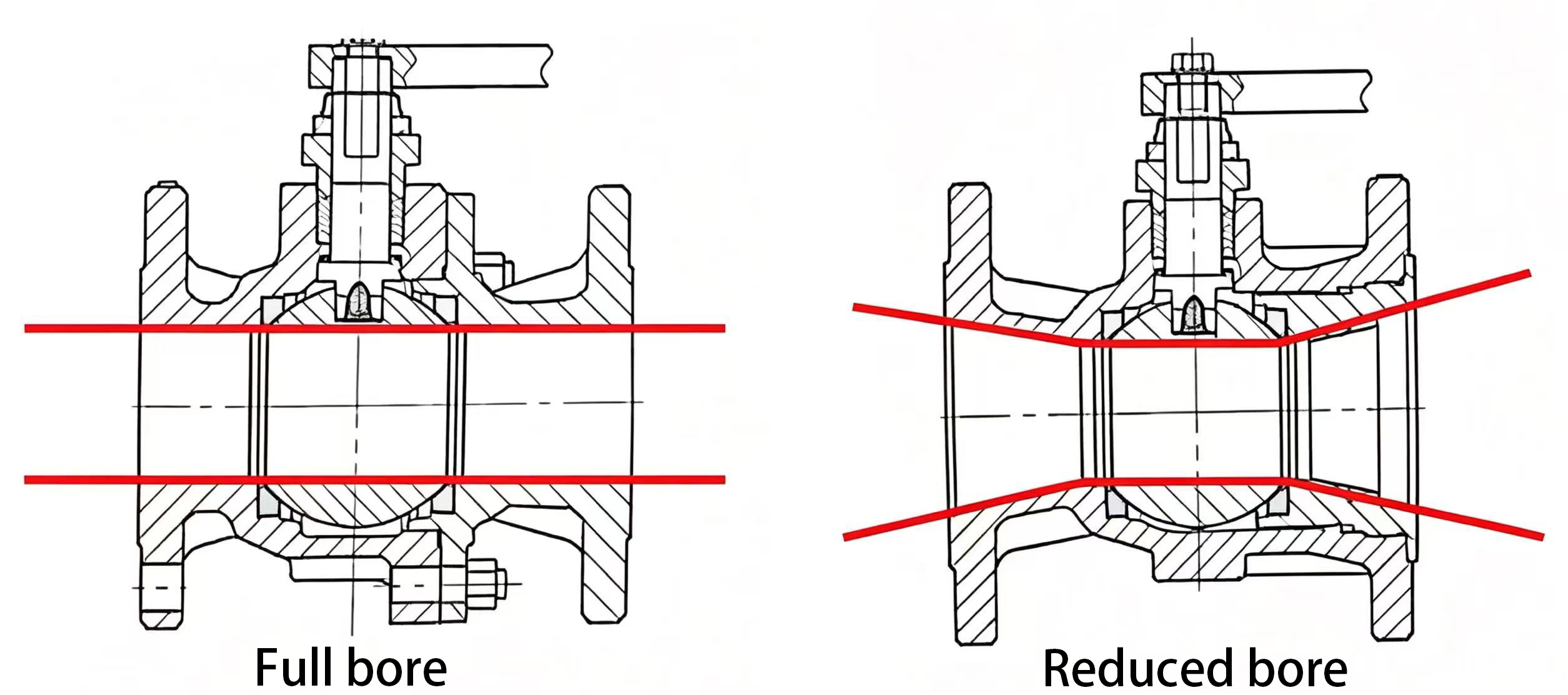
Both floating and trunnion mounted ball valves can be supplied as full port or reduced port designs.
A full port ball valve has a bore close to the internal diameter of the pipeline. It reduces pressure drop and is preferred when pigging, flushing, high flow or minimal restriction is required.
A reduced port ball valve has a smaller bore through the ball. It is more compact and economical, but it creates more flow restriction. Reduced port valves are common in general isolation service where maximum flow capacity is not critical.
For API 6D pipeline service, full bore trunnion mounted ball valves are common because pipelines may require pigging and low pressure drop. For smaller utility lines, a reduced port floating ball valve may be a practical and cost-effective option.
Stainless Steel Material Considerations
Both valve types can be made from stainless steel, but material selection must match the service conditions.
Common stainless steel options include:
- 304 stainless steel for water, air and mild chemical service
- 316 stainless steel for better chloride and marine corrosion resistance
- Duplex stainless steel for higher strength and chloride stress corrosion resistance
- Special alloys for severe corrosion, high temperature or sour service
Seat and seal materials are just as important as the body material. PTFE, RPTFE, PEEK, graphite and elastomer seals have different temperature, pressure and chemical limits. For sour gas or sour liquid service, the project may also require materials that meet NACE MR0175/ISO 15156 or related sour service rules.
Cost Difference
Floating ball valves are usually less expensive because the design is simpler. They use fewer internal support parts, are lighter in small sizes and are widely available.
Trunnion mounted ball valves cost more because they require additional components, precise machining, stronger support design and more complex seat construction. They may also include features such as body cavity relief, drain and vent connections, DBB capability, sealant injection fittings or special testing.
However, the lowest purchase price is not always the lowest life-cycle cost. In a large high-pressure line, a floating valve may require a larger actuator, produce higher torque or experience faster seat wear. In that case, a trunnion mounted ball valve may be more economical over the life of the system.
Which Ball Valve Type Should You Choose?
Choose a floating ball valve when:
- The line size is small to medium
- Pressure is low to moderate
- Cost and compact size matter
- The medium is clean or mildly corrosive
- The valve is used for general isolation
- Manual operation is acceptable
Choose a trunnion mounted ball valve when:
- The line size is medium to large
- Pressure or differential pressure is high
- Low operating torque is important
- The valve will be automated
- Pipeline isolation is critical
- DBB or DIB function is required
- API 6D pipeline service is specified
Before final selection, confirm the real process conditions, not only the pipe size. Review pressure class, temperature, flow rate, pressure drop, medium, corrosion risk, actuation, leakage expectation, maintenance access and applicable standards.
Application Examples
| Application | Recommended design | Reason |
|---|---|---|
| Small water treatment skid | Floating ball valve | Compact and economical |
| Stainless steel chemical dosing line | Floating ball valve | Good shutoff in small process piping |
| Natural gas transmission pipeline | Trunnion mounted ball valve | Large size, high pressure and low torque |
| Refinery isolation service | Trunnion mounted ball valve | Critical shutoff and demanding conditions |
| HVAC chilled water branch | Floating ball valve | Practical and cost-effective |
| Offshore process line | Trunnion mounted ball valve | Higher reliability and material options |
| Pigged pipeline | Full port trunnion mounted ball valve | Maintains full bore for pigging |
| Drain or vent line | Floating ball valve | Simple isolation and low cost |
Final Thoughts
The main difference between a trunnion mounted ball valve and a floating ball valve is the way the ball is supported and sealed. In a floating ball valve, pressure pushes the ball against the downstream seat. In a trunnion mounted ball valve, the ball is mechanically supported, and the seats move toward the ball.
Floating ball valves are simple, compact and economical for smaller stainless steel piping systems. Trunnion mounted ball valves are stronger, easier to operate in large or high-pressure service and better suited for API 6D pipeline applications.
For the best result, select the valve based on pressure, size, torque, media, material, operation method and required standards. A well-specified ball valve will provide reliable shutoff, easier operation and longer service life.
FAQ
What is the main difference between a floating ball valve and a trunnion mounted ball valve?
The main difference is ball support. A floating ball valve allows the ball to move slightly downstream and seal against the seat. A trunnion mounted ball valve fixes the ball with mechanical supports, while the seats move toward the ball to create sealing.
Which is better, trunnion mounted or floating ball valve?
Neither design is always better. Floating ball valves are better for smaller, moderate-pressure and cost-sensitive applications. Trunnion mounted ball valves are better for larger, higher-pressure, automated or critical pipeline applications.
Can a floating ball valve be API 6D?
Yes. A floating ball valve can be supplied to API 6D when it is designed, manufactured, tested, marked and documented according to the required specification. The purchaser still needs to confirm pressure, size, torque, material and service conditions.
Why do trunnion mounted ball valves have lower torque?
The ball is supported by trunnions, so line pressure does not push the full ball load into the downstream seat. This reduces friction and keeps operating torque lower, especially in large or high-pressure valves.
Does API 6D require trunnion mounted ball valves?
API 6D does not automatically require every ball valve to be trunnion mounted. It defines requirements for pipeline and piping valves. The valve design should be selected according to size, pressure, operation, sealing function and project specification.
Can both designs be made from stainless steel?
Yes. Floating and trunnion mounted ball valves can both be made from 304 stainless steel, 316 stainless steel, duplex stainless steel or special alloys. The correct material depends on the medium, temperature, pressure and corrosion environment.
What is the best ball valve type for pigging?
A full port trunnion mounted ball valve is commonly used for piggable pipelines because it can maintain a full bore flow path while supporting large sizes and higher pressures.
Need Help Selecting Stainless Steel Ball Valves?
JIANENG Valve supports global buyers with floating and trunnion mounted ball valve selection, stainless steel material matching, actuator sizing and API 6D project documentation.
Contact Our Technical Team