Automated valves are used in water treatment, chemical plants, oil and gas systems, power stations, HVAC networks and process skids. When a valve must open, close or modulate automatically, pneumatic and electric actuators are two of the most common choices.
Pneumatic valves use compressed air to move the actuator. Electric valves use an electric motor and gearbox. Both can automate ball valves, butterfly valves, globe valves and other industrial valve types, but the better option depends on available utilities, required speed, fail-safe position, cycle frequency, control accuracy, maintenance conditions and total installed cost.
This guide compares both actuator types from a practical process-selection point of view.
Quick Answer: Pneumatic or Electric?
Choose pneumatic
Best when reliable instrument air is available and the process needs fast travel, frequent cycling or straightforward spring-return fail-open or fail-close action.
Choose electric
Best when compressed air is unavailable, wiring is simpler than running air lines, cycling is less frequent or integrated electronic feedback is useful.
Neither option is always better. Compare the complete valve assembly and site conditions instead of comparing actuator purchase prices alone.
Pneumatic Valves vs Electric Valves at a Glance
| Comparison factor | Pneumatic valves | Electric valves |
|---|---|---|
| Main power source | Compressed air | Electric power |
| Typical motion | Fast quarter-turn or linear travel | Motor-driven quarter-turn, multi-turn or linear travel |
| Installation needs | Air supply, tubing and control accessories | Power supply and control wiring |
| Common accessories | Solenoid valve, air filter regulator, limit switch and positioner | Limit and torque switches, local control and feedback module |
| Operating speed | Usually faster | Usually slower, depending on design |
| Fail-safe action | Direct with a spring-return actuator | Requires a suitable spring-return, battery, capacitor or backup-power design |
| Frequent cycling | Well suited when correctly sized | Depends on the actuator duty rating |
| Modulating service | Strong option with a positioner | Strong option with a modulating actuator |
| Maintenance focus | Air quality, seals, tubing and accessories | Motor, gearbox, wiring, enclosure and electronics |
| Typical fit | Process plants with instrument air and fast automation needs | Remote sites, utility systems and locations without compressed air |
What Are Pneumatic Valves?
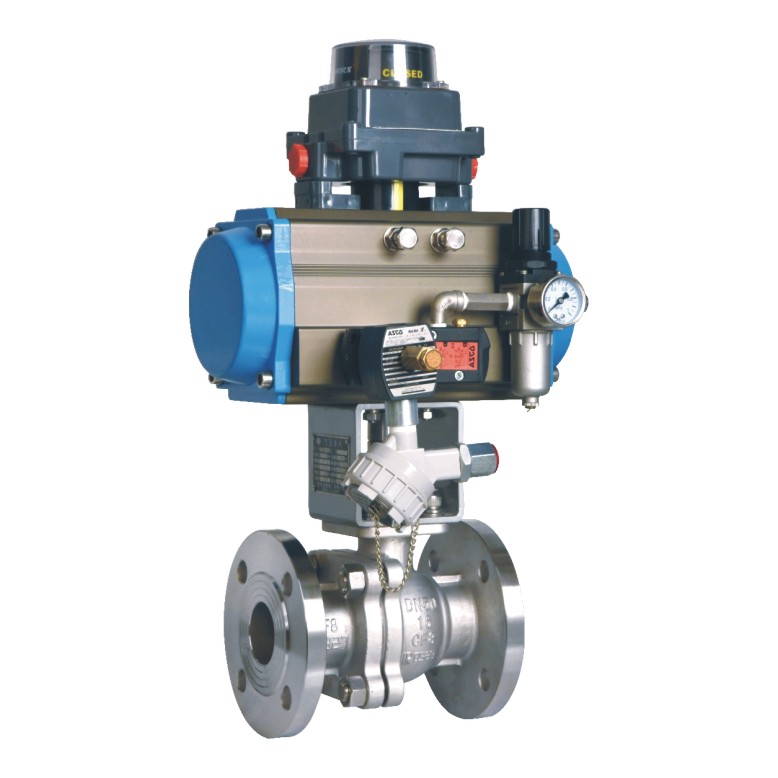
A pneumatic valve is a valve assembly operated by a pneumatic actuator. The actuator converts compressed-air pressure into mechanical motion, which moves the valve stem, shaft, plug, disc or ball to open, close or regulate flow.
The term can describe complete assemblies such as pneumatic ball valves, pneumatic butterfly valves, pneumatic control valves and pneumatic shutoff valves. The valve body controls the process fluid while the actuator supplies movement.
Typical uses include:
- On/off automation for ball and butterfly valves
- Modulating control with globe control valves
- Emergency shutdown and process isolation
- Steam, water, gas and chemical process control
- High-cycle systems and production lines
- Applications requiring a defined fail-open or fail-close position
Common Pneumatic Actuator Types
Linear pneumatic actuators
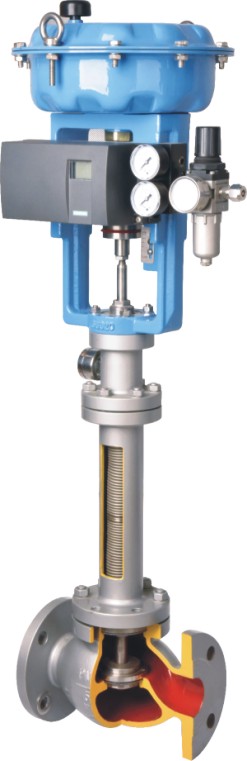
Linear actuators move the valve stem in a straight line. Diaphragm actuators are common on globe control valves because they provide smooth travel and straightforward spring-return action. Piston actuators can provide greater thrust for larger valves, higher pressure drops or longer travel.
Quarter-turn pneumatic actuators
Quarter-turn actuators rotate the valve shaft by about 90 degrees and are commonly paired with ball, butterfly and plug valves.
- Rack-and-pinion: compact and widely used for standard ball and butterfly valve automation.
- Scotch yoke: provides a torque profile suited to larger valves and demanding shutoff duties.
What Are Electric Valves?
An electric valve uses an electric actuator containing a motor, gearbox and control components. Depending on the valve, the actuator may provide quarter-turn, multi-turn or linear motion.
Electric actuators do not need compressed air. For basic on/off duty, the valve may only require the correct power supply and open-close control wiring. More advanced units can provide position feedback, torque protection, modulating control, fieldbus communication and local manual override.
Electric valves are especially practical when:
- The site has no instrument-air system
- Running air tubing would be difficult or expensive
- The valve operates occasionally rather than continuously
- Slow, controlled movement is acceptable or desirable
- Integrated electronic monitoring and diagnostics are useful
Installation: Air Supply vs Power Supply
A pneumatic valve needs clean, dry and stable compressed air. A complete package can also require air tubing, fittings, an air filter regulator and electrical accessories that connect the valve to a PLC or DCS.
Common pneumatic accessories include:
- Solenoid valve for electrical-to-pneumatic switching
- Air filter regulator for supply-air preparation
- Limit switch box or position transmitter for feedback
- Positioner for modulating control
- Speed controller or quick exhaust valve when the travel time must be adjusted
An electric valve needs a compatible electrical supply and control wiring. Modulating units may also use a 4–20 mA, 0–10 V or digital communication signal, but they do not need air tubing or an air-preparation package.
Speed and Cycle Frequency
Pneumatic actuators are usually faster than electric actuators. Correctly sized quarter-turn pneumatic valves can operate quickly, which is useful for high-cycle production and emergency shutdown duties.
Electric actuators generally travel more slowly because a motor and gearbox drive the valve. Controlled slow movement can be useful where rapid closure could create hydraulic shock.
Always check the required cycle rate and actuator duty rating. A pneumatic actuator may be a good high-cycle choice, while an electric actuator needs a motor duty rating that matches the operating frequency.
Fail-Safe Action and Process Safety
A spring-return pneumatic actuator stores energy mechanically. If the air supply is lost, the spring moves the valve to its specified safe position. This makes fail-open or fail-close configurations comparatively direct.
Electric actuators can also provide fail-safe movement, but the function must be selected explicitly. Possible designs use a spring-return mechanism, battery, capacitor or emergency power source. A standard electric actuator should not be assumed to move during a power failure.
For hazardous areas, choose the complete actuator and accessory package for the actual area classification. Pneumatic actuation can reduce electrical equipment at the valve, but solenoids, switches and positioners still require appropriate protection where they are installed.
Control Accuracy and Modulating Service
Pneumatic diaphragm actuators with positioners are widely used for modulating globe control valves. Rotary pneumatic actuators can also provide modulating control when paired with a suitable positioner.
Electric modulating actuators are useful where air is unavailable or integrated electronic control is preferred. They can receive analog or digital commands and move to a requested position.
Power source alone does not determine control quality. Valve sizing, inherent flow characteristic, actuator resolution, dead band, backlash and response time all affect the final loop performance. For control-valve selection, see our guide to industrial control valve types.
Cost and Maintenance
The lower actuator price is not necessarily the lower installed cost. If instrument air already exists, pneumatic automation can be economical and easy to standardize. If the site has no compressed-air infrastructure, electric actuation may avoid the cost of compressors, dryers and air distribution.
Pneumatic maintenance focuses on air quality, seal condition, tubing leakage, solenoid operation and positioner calibration. Electric maintenance focuses on wiring, motor condition, gearbox wear, limit switches, enclosure sealing and electronics.
For either technology, size the actuator using the valve's required torque or thrust at the maximum specified differential pressure and temperature. Confirm an appropriate safety factor without exceeding the valve stem or shaft limits.
Which Is Better for Different Applications?
| Application condition | Likely starting point | Selection reason |
|---|---|---|
| Reliable plant instrument air | Pneumatic | Fast operation and plant-wide standardization |
| Remote site without compressed air | Electric | Uses local power and control wiring |
| Emergency shutdown duty | Pneumatic | Spring-return fail-safe action is direct |
| Infrequent utility-valve operation | Electric | No continuous air system is needed |
| High-cycle automation | Pneumatic | Good speed and cycling capability |
| Large valve requiring slow travel | Electric | Gear drive can provide controlled movement |
| Globe control valve in a process plant | Pneumatic | Diaphragm actuator and positioner are widely used |
| Water treatment or HVAC utility valve | Electric | Can simplify installation where air is unavailable |
| Hazardous area | Project-specific | Area classification and equipment certification govern the choice |
| Integrated digital diagnostics | Electric | Many designs include electronic feedback and communication |
Common Selection Mistakes
- Comparing actuator prices only: include tubing, wiring, air preparation, control accessories and infrastructure.
- Assuming pneumatic means no electricity: solenoids, limit switches, positioners and transmitters often use electrical signals.
- Ignoring air quality: wet or contaminated air can damage seals and pneumatic accessories.
- Ignoring electric duty cycle: a motor must be rated for the required operating frequency.
- Assuming fail-safe action: define the required position after loss of air, power or control signal.
- Sizing from nominal valve size alone: use the manufacturer's torque or thrust data for the actual process conditions.
How to Choose the Actuator
Build the specification around the process requirement:
- Confirm whether instrument air is available at the valve location.
- Record the available electrical supply and control signal.
- Define fail-open, fail-close or fail-in-place behavior.
- Set the required opening and closing time.
- Record operating frequency and duty cycle.
- Choose on/off or modulating control.
- Calculate maximum differential pressure and required valve torque or thrust.
- Confirm area classification, ingress protection and ambient conditions.
- List the required open, closed and continuous-position feedback.
Final Thoughts
Pneumatic valves are fast, robust and well suited to plants with instrument air, frequent cycling and spring-return fail-safe requirements. Electric valves are practical where compressed air is unavailable and can simplify utility or remote installations.
The best selection matches the real process conditions. Compare motion, speed, torque or thrust, fail position, utilities, accessories, environment and maintenance capability before specifying the automated valve package.
Frequently Asked Questions
Are pneumatic valves better than electric valves?
Pneumatic valves are often better for fast travel, frequent cycling and spring-return fail-safe action. Electric valves are often better where compressed air is unavailable or a self-contained motor actuator is preferred.
Do pneumatic valves need electricity?
Compressed air powers the actuator movement, but automated pneumatic valves commonly use electrical solenoids, limit switches, positioners or feedback transmitters to connect with a control system.
What accessories are needed for pneumatic valves?
The package may include a solenoid valve, air filter regulator, limit switch box, positioner, feedback transmitter and speed controller. The exact accessories depend on whether the service is on/off, modulating or fail-safe.
Are electric valves easier to install?
They can be easier where compressed air is unavailable. Basic on/off actuators need the correct power and control wiring, while modulating or networked units need additional signals or communication.
Which actuator types are common for pneumatic valves?
Diaphragm and piston actuators provide linear motion. Rack-and-pinion and scotch yoke actuators provide quarter-turn motion.
Which actuator is better for control valves?
Pneumatic diaphragm actuators with positioners are common in process plants. Electric modulating actuators are also suitable when instrument air is unavailable. Required response, resolution, utilities and maintenance determine the better choice.
Need Help Selecting an Automated Valve?
Share your valve type, size, pressure, medium, available utilities, control signal and required fail position. JIANENG Valve can help match the valve, actuator and accessory package to the application.
Discuss Your Application