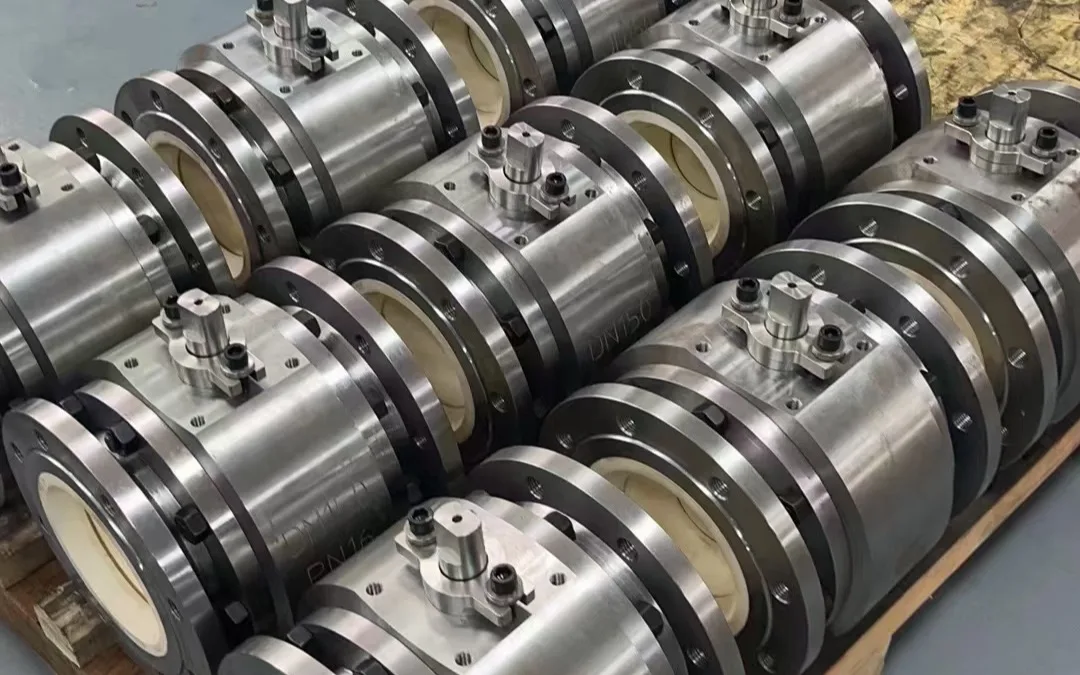
A flanged ball valve uses bolted flange connections to join a pipeline and a rotating ball to open or close the flow path. It is a practical isolation option where the valve must be installed as a removable assembly, but selecting it requires more than matching nominal size and bolt holes. Flange standard, facing, pressure-temperature rating, seat materials and operating torque must all suit the service.
This guide helps engineers and procurement teams turn a short request such as “DN50 flanged ball valve” into a specification that suppliers can quote consistently.
Key Takeaways
- “Flanged” describes the end connection only; floating vs trunnion, full vs reduced bore and soft vs metal seat are separate design decisions.
- Name the flange standard (ASME B16.5, EN 1092-1 etc.), rating class, facing and gasket, not just the nominal size.
- Pressure class is a designation, not a universal working-pressure limit. Check the pressure-temperature rating at the actual operating temperature.
- Body material is only one compatibility decision; specify ball, stem, seats, body seals and packing as a complete wetted-material set.
- An actuator mounting pattern does not prove the bracket, coupling and stem can carry the maximum transmitted torque.
What Defines a Flanged Ball Valve
“Flanged” describes the end connection. It does not identify the ball-support arrangement, body construction or seat system. A flanged valve can be floating or trunnion mounted, full bore or reduced bore, soft seated or metal seated, and manually or automatically operated.
These choices affect different parts of the specification. Ball support influences how pressure loads are handled. Body construction affects maintenance access and pressure-boundary joints. Bore size affects flow capacity and pressure loss. The end connection determines the mechanical interface with the piping.
For the broader design categories, see Ball Valve Types: Designs, Applications and Selection Guide. Keep these categories separate when comparing quotations: two products with identical flanges may have different internal designs and service capabilities.
Flange Compatibility and Pressure Rating
Name the connection standard
Specify the nominal size, flange standard, rating designation and facing. ASME and EN flange systems can differ in dimensions and bolting even when the nominal pipe sizes appear comparable. A DN designation alone does not establish compatibility with an NPS flange connection.
ASME B16.5 covers defined sizes and classes of pipe flanges and flanged fittings, including dimensions and pressure-temperature ratings. The relevant project specification may instead call for another standard. Use the specified edition and the actual mating-flange drawing when replacing an existing valve.
Check the facing as well. Raised-face, flat-face and ring-type-joint arrangements have different sealing details. Gasket material, dimensions and bolt loading must match the joint design. Do not treat a flange that physically fits the bolt pattern as proof that the complete joint is suitable.
Read ratings at the actual temperature
Class 150 is a pressure class designation, not a universal working-pressure limit of 150 psi. The allowable pressure depends on material and temperature, while the valve seat, seals or other components may impose a lower limit than the metallic body.
ASME B16.34 addresses new valve construction, including pressure-temperature ratings, materials, examination, testing and marking within its scope. Compliance with a flange standard alone does not establish compliance with every valve design or test requirement.
For example, a request for a valve operating at 10 bar(g) and 120 °C should be checked at that temperature for the complete offered assembly. A catalog’s room-temperature maximum is insufficient. Include design conditions, startup conditions and credible pressure transients separately from normal operation.
The article Ball Valve Standard Guide: API, ASME and ISO Explained helps separate design, dimensional, pressure-test and special qualification requirements.
Bore, Seats and Operation
Choose the bore for the duty
A full-bore design can reduce restriction compared with a smaller bore, but actual bore dimensions and flow coefficients remain manufacturer-specific. Reduced-bore designs may be acceptable where calculated pressure loss and flow velocity meet the project requirements.
If pigging is required, “full bore” is only a starting point. Confirm the passage dimensions, internal geometry, associated fittings and suitability for the selected pig. If solids or viscous fluids are present, review cavity behavior, drainage and accumulation as well as the main flow path.
Specify the complete wetted-material set
The body material is only one compatibility decision. Identify the ball, stem, seats, body seals and packing. Soft seats may suit clean fluids and demanding shutoff requirements, while abrasive or elevated-temperature service may require a different seating system.
Avoid prescribing a universal temperature limit from the polymer name alone. Seat formulation, reinforcement, geometry, pressure and cycling all affect the qualified operating envelope. Ask for the offered valve’s pressure-temperature curve and limitations.
Decide how the valve will operate
A handle-operated valve needs adequate access and operating clearance. A gearbox may be needed when direct operating effort is unsuitable. Automated packages need the valve torque data and actuator output evaluated at actual supply conditions.
For pneumatic operation, specify minimum air pressure and the required failure position. For electric operation, specify power supply, operating time, duty and control interface. The actuator mounting pattern does not prove that the shaft, bracket and coupling are strong enough for the maximum transmitted torque.
Installation Planning
Before ordering a replacement, measure the installed face-to-face space and confirm the drawing. Matching the connection standard does not guarantee identical overall length or actuator clearance. Include insulation, supports and access needed to remove bolts.
During installation planning, address these points:
- Support the pipe and valve so the body does not carry uncontrolled piping loads.
- Inspect flange faces, gasket condition and cleanliness before joint assembly.
- Align the pipework without using flange bolts to pull a misaligned line into position.
- Follow the approved bolting procedure and the manufacturer’s assembly instructions.
- Confirm operating travel, handle clearance and accessory access before commissioning.
Opening a body joint requires isolation, depressurization and control of trapped cavity pressure. A flanged connection makes removal possible after the system is made safe; it does not make an installed valve maintainable under pressure.
A Practical Purchasing Checklist
| RFQ field | Information to provide |
|---|---|
| Service | Fluid composition, contamination and purpose |
| Conditions | Normal and design pressure and temperature |
| Piping interface | Size, flange standard, class or PN, facing and face-to-face requirement |
| Flow passage | Required bore, allowable loss and pigging needs |
| Materials | Body, ball, stem, seats, packing and seals |
| Operation | Manual, gearbox, pneumatic or electric; torque and fail action |
| Verification | Required tests, documents and any special qualifications |
Use the same checklist to compare bids. If one supplier quotes reduced bore and another full bore, or one includes an actuator and another a bare valve, resolve those differences before comparing prices.
Frequently Asked Questions
Are flanged ball valves better than threaded ball valves?
The better connection depends on piping size, rating, installation practice and maintenance needs. Flanges provide a bolted interface and require more installation space. Threaded valves can suit compact systems, but their thread standard and sealing method must be checked. Neither connection alone guarantees better performance.
Does a stainless steel body make the valve corrosion-proof?
No. Suitability depends on the alloy, fluid chemistry, concentration, temperature and operating conditions. Seats, seals and packing must also be compatible. Specify the complete wetted-material set and ask the supplier to review the actual medium rather than accepting “stainless steel” as a complete material specification.
Can a flanged ball valve throttle continuously?
Some ball-valve designs are engineered for control duty, but ordinary isolation designs should not be assumed suitable for sustained throttling. Review flow characteristic, differential pressure, velocity, seat erosion and actuator performance. Specify control service explicitly so the supplier can evaluate the appropriate ball and seat design.
Name the connection, the rating and the bore — in that order. Most flanged ball valve purchasing problems come from one of those three being assumed. A complete RFQ states the flange standard and facing, the pressure-temperature rating at the actual operating temperature, and the bore type, so that quotations can be compared on a common technical basis.
Conclusion
A reliable flanged ball valve selection connects process requirements with the piping interface and the internal design. Flange standard, pressure-temperature rating, bore, wetted materials and operating method must each be defined in the specification, then verified against the actual offered assembly.
For an inquiry, share the fluid composition, normal and design pressure and temperature, the mating-flange standard and facing, the required bore and any pigging need, the complete wetted-material set and the intended operating method. Jianeng Valve can review the operating conditions and help organize a technically consistent quotation before commercial award.
Technical Sources
- ASME, B16.5 — Pipe Flanges and Flanged Fittings (NPS 1/2 through NPS 24), accessed October 9, 2026.
- ASME, B16.34 — Valves Flanged, Threaded and Welding End, accessed October 9, 2026.
Sources verified October 9, 2026.
Need Help Specifying a Flanged Ball Valve?
Share the fluid composition, normal and design pressure and temperature, the mating-flange standard and facing, the required bore and any pigging need, the complete wetted-material set and the intended operating method. JIANENG Valve can review the operating conditions and help organize a technically consistent quotation before commercial award.
Discuss Your Application