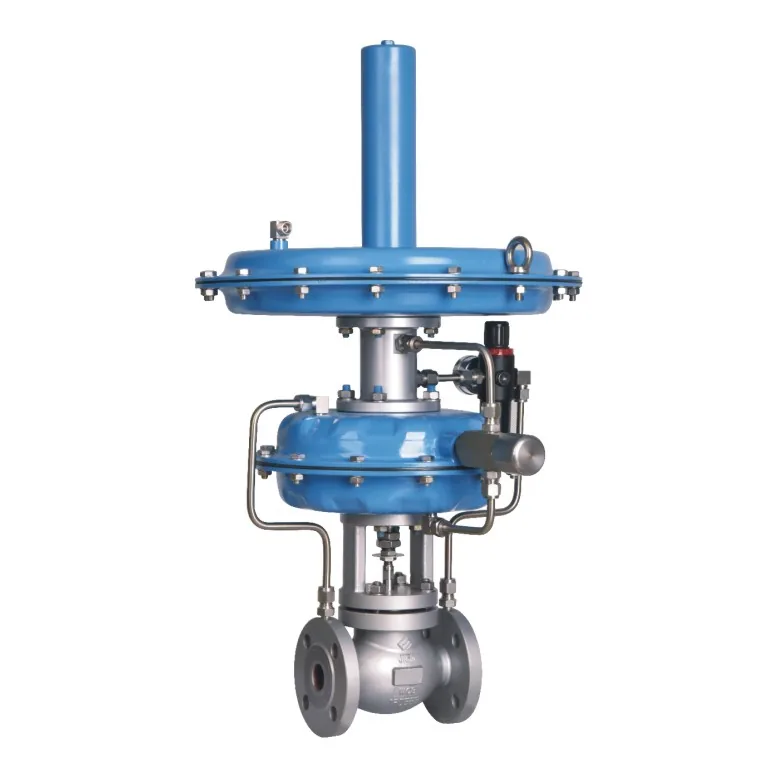
A pilot operated pressure regulator uses a small pilot valve to control the loading pressure or pressure balance that positions a larger main valve. In pressure-reducing service, the assembly senses downstream pressure and adjusts the main flow opening to keep that pressure near its setpoint as demand changes.
Pilot operation can be useful when the required capacity or pressure stability is difficult to obtain from a simple direct-acting arrangement. Selection still depends on the medium, pressure differential, flow range and installation. The label “pilot operated” does not guarantee stable control under every load condition.
Key Takeaways
- State whether the regulator controls pressure upstream or downstream. A request for “5 bar regulator” without that information leaves the controlled pressure undefined.
- Pilot operation adds control capability, not guaranteed accuracy. Demand the pressure-flow envelope rather than a single capacity figure.
- Confirm the minimum operating differential and check the low-flow end, where a regulator that passes maximum demand may hunt or cycle.
- Treat the sensing line and pilot circuit as part of the regulator; a blocked pilot passage or a closed isolating valve stops control entirely.
- A regulator controls normal operating pressure. It is not automatically a certified overpressure-protection device for a failure-open event.
How a Pilot Operated Pressure Regulator Works
The pilot compares a sensed pressure with a setting established by its loading arrangement. In a pressure-reducing configuration, a fall in downstream pressure calls for more flow. The pilot changes the pressure acting on the main valve’s diaphragm or piston so that the main valve opens further.
As downstream pressure recovers, the pilot reduces the demand for main-valve opening. The details of loading, unloading, restrictions and exhaust paths differ by design. A schematic from one regulator should not be used as the tubing instruction for another.
Spirax Sarco’s self-acting pressure-control tutorial describes direct-acting and pilot-operated arrangements for steam service. It also distinguishes pressure-reducing regulators, which sense downstream pressure, from pressure-maintaining arrangements that sense upstream pressure.
This distinction belongs at the start of an RFQ. A request stating only “pressure regulator, 5 bar” leaves the supplier unsure whether 5 bar is the inlet pressure, required outlet setting or upstream pressure to be maintained. Our back pressure regulator guide covers the upstream-maintaining case in detail.
Pilot Operated Versus Direct Acting
| Selection issue | Direct-acting arrangement | Pilot-operated arrangement |
|---|---|---|
| Control mechanism | Sensing element acts directly on the main restriction | Pilot controls the main valve’s pressure balance |
| Package complexity | Usually fewer control components | Additional pilot passages and associated components |
| Load response | Evaluate the product’s pressure-flow curve | Evaluate both pilot and main-valve behavior |
| Installation focus | Correct sizing and pressure sensing | Correct sizing, sensing and pilot-circuit installation |
| Maintenance focus | Main seat, sensing element and loading mechanism | Those items plus pilot restrictions and connections |
Do not select pilot operation merely because it sounds more accurate. If the load is modest and the allowed pressure variation is broad, a simpler design may be adequate. If demand varies widely, ask both suppliers to demonstrate performance over the actual range.
Pressure-reducing regulators can exhibit droop: outlet pressure changes as flow demand increases. Swagelok’s explanation of regulator flow curves discusses how loading arrangements influence this behavior. The purchasing implication is to request a pressure-flow envelope, not just a maximum capacity figure.
Sizing and Operating-Range Checks
Record pressure and flow together
Provide minimum, normal and maximum demand with the corresponding inlet pressure and required outlet-pressure tolerance. Include inlet-pressure variation from the supply system. A regulator sized at the highest supply pressure may be unable to deliver maximum demand when that supply falls.
For an illustrative steam inquiry, normal inlet pressure might be 8 bar(g), minimum inlet pressure 6 bar(g), and required outlet pressure 3 bar(g). Demand might vary from 100 to 600 kg/h. These values define several operating cases, not a finished valve size. Steam condition, pipe sizes and the selected regulator’s capacity method are still required.
Check minimum differential pressure
Many pilot-operated designs need a specified pressure differential to operate the main valve reliably. Confirm that the available differential meets the product requirement at maximum demand and during startup. A nominal pressure difference calculated from static gauges may overstate the pressure available under flowing conditions.
Review low-flow and no-flow behavior
Ask about minimum stable flow, outlet-pressure rise as flow approaches zero, and shutoff behavior. A regulator that passes maximum demand may hunt or cycle at a much smaller load. If the operating range exceeds one regulator’s useful envelope, discuss a suitable staged or parallel arrangement with the designer rather than simply increasing body size.
For the wider steam selection context, see Steam Control Valve: Sizing, Selection and Installation. A regulator and an externally controlled valve may meet different control and integration needs even when they serve the same line.
Sensing Lines and Installation
An external sensing line must measure a representative pressure at the location specified by the manufacturer. Turbulence, restrictions, leakage or an accidentally closed isolating valve can cause the regulator to respond to the wrong pressure. Routing and connection details depend on the medium and regulator design.
For steam duty, review moisture separation, strainers, drainage, pipe sizing and the location of pressure gauges. Condensate management affects the operation of the complete station. The related guide Float Type Steam Trap: Working Principle and Selection explains the drainage component of a steam system.
Also evaluate downstream equipment protection. A pressure-reducing regulator controls normal operating pressure; it is not automatically a certified overpressure-protection device. The system design must address the consequences of a regulator failing open, including the maximum upstream pressure and the capacity of any required protective arrangement.
Troubleshooting and RFQ Information
| Symptom | Questions to investigate |
|---|---|
| Outlet pressure falls at high demand | Is inlet pressure adequate, and are the regulator or upstream components undersized? |
| Pressure oscillates | Is the regulator oversized, the load unstable, or the sensing circuit incorrect? |
| Outlet pressure rises at no flow | Is this specified lock-up behavior or continuing seat leakage? |
| Main valve fails to respond | Are pilot passages blocked or operating differential and loading pressure insufficient? |
Treat these as diagnostic starting points, not proof of a failed component. Record upstream pressure, downstream pressure, flow and operating state before adjusting the setpoint or replacing parts.
An effective RFQ includes medium and phase, fluid properties, pressure and temperature envelope, flow cases, required pressure tolerance, connection standard, materials, sensing arrangement and installation constraints. Request capacity confirmation, minimum differential, stable flow range and a model-specific installation drawing. Our pilot operated regulator range covers the main arrangements most often supplied for these duties.
Frequently Asked Questions
Does a pilot operated regulator need electricity?
Many self-operated designs use process pressure as their operating energy and do not require electrical power. Other packages can include remote adjustment or electronic accessories. Confirm the utilities required by the complete offered assembly rather than assuming that every pilot-operated regulator is entirely self-contained.
Is it the same as a pilot operated relief valve?
No. Pilot operation describes the control mechanism, not the service function. A pressure-reducing regulator controls downstream operating pressure, while a relief application serves a different purpose and acceptance basis. Specify the function, required behavior and applicable qualification rather than relying on the word “pilot.”
Can one regulator serve a very wide demand range?
Possibly, but it must operate stably at the lowest demand as well as pass the highest demand. Compare the required range with the manufacturer’s performance data. A larger nominal size can worsen low-flow behavior, so ask for documented operating cases before selecting the body size.
Define the controlled pressure before anything else. The wording of an inquiry decides whether the supplier builds a pressure-reducing regulator, a back pressure regulator or a relief device. Naming the controlled location, the inlet variation and the load cases removes the most common source of a mis-ordered valve.
Conclusion
Select a pilot operated pressure regulator from the complete pressure-flow envelope and installation arrangement. Once the function and the controlled location are settled, the remaining work is a straightforward engineering review: confirm the minimum differential, check the low-flow end, verify the sensing arrangement and treat overpressure protection as a separate duty.
For an inquiry, share the controlled pressure location, the medium, the inlet pressure variation, the load cases, the required pressure tolerance and the sensing arrangement. Jianeng Valve can use those inputs to review the regulator configuration and the proposed installation before commercial award.
Technical Sources
- Spirax Sarco, Self-acting Pressure Controls and Applications, accessed October 26, 2026.
- Swagelok, How to Flatten a Regulator Flow Curve to Reduce Droop, accessed October 26, 2026.
Sources verified October 26, 2026.
Need Help Specifying a Pilot Operated Pressure Regulator?
Share the controlled pressure location, the medium and phase, the inlet pressure variation, the flow cases, the required pressure tolerance, the sensing arrangement and the installation constraints. JIANENG Valve can review the pressure-control duty and confirm whether the regulator holds its setpoint across the complete demand range, not only at the easiest operating point.
Discuss Your Application