A 3-way valve has three ports and controls how fluid is combined, divided or switched between flow paths. The right design depends on whether the service needs mixing, diverting, flow selection or continuous modulation.
Three-way valves are used in industrial piping, HVAC systems, water treatment equipment and process skids. They can simplify a piping arrangement when the system needs to change flow direction, blend two streams or route one stream through different lines.
Quick Answer: What Does a 3-Way Valve Do?
A 3-way valve connects three pipe ports and controls how flow moves between them. It can mix two inlet flows into one outlet, divert one inlet flow to either of two outlets, or switch flow between different paths.
Mixing service
Two streams enter the valve and leave through one common outlet. This is common in temperature control, blending and HVAC loops.
Diverting service
One stream enters the common port and is sent to one or two outlets. This is common in bypasses, routing and flow selection.
- A 3-way valve means one valve body with three connection ports.
- Mixing combines two inlet streams into one outlet.
- Diverting sends one inlet stream to one or two outlets.
- L-port and T-port designs create different flow paths.
- Ball valves are common for switching, while globe control valves are common for modulating.
3-Way Valve Functions at a Glance
| Function | Flow pattern | Common valve design | Typical use |
|---|---|---|---|
| Mixing | Two inlets, one outlet | 3-way globe valve or T-port ball valve | Temperature control, blending |
| Diverting | One inlet, two outlets | 3-way globe valve or L-port ball valve | Bypass, flow distribution |
| Flow selection | One source to one of two lines | L-port ball valve | Tank selection, process switching |
| Common-port switching | Common port connects to different ports | L-port or T-port ball valve | Utility systems and skids |
| Bypass control | Flow split between process and bypass | 3-way control valve | Heat exchangers, pumps, coils |
What Is a 3-Way Valve?
A 3-way valve is a valve with three openings, usually called ports. Depending on the design, the ports may be arranged in a T pattern, L pattern, side-entry pattern or globe body arrangement.
The ports are often labeled A, B and AB. In many control valve applications, AB is the common port. In mixing service, A and B may be inlets and AB may be the outlet. In diverting service, AB may be the inlet and A or B may be outlets.
The valve may be operated manually, pneumatically or electrically. It may be used for simple on/off switching or for modulating control.
Common 3-way valve types include:
- 3-way ball valve
- 3-way globe control valve
- 3-way plug valve
- 3-way butterfly valve in special arrangements
- 3-way sanitary valve
- Motorized or pneumatic 3-way valve
The right choice depends on whether the application needs tight shutoff, accurate control, high flow, corrosion resistance, easy cleaning or fast switching.
Mixing Service Explained
In mixing service, the 3-way valve combines two flows into one outlet. This is common when two streams must be blended to reach a target temperature, concentration or process condition.
A typical example is a hot-water and cold-water mixing loop. Hot water enters one port, cooler return water enters another port, and mixed water exits through the common port. By adjusting the valve position, the system changes the ratio of hot and cold flow.
Mixing service is common in:
- HVAC heating and cooling systems
- Heat exchanger temperature control
- Boiler and chiller loops
- Chemical blending
- Process water temperature control
- Jacketed vessel temperature control
- Food and beverage processing
For accurate mixing control, a 3-way globe control valve is often preferred because it can modulate flow more smoothly. A 3-way ball valve can also be used when the application is mainly switching or when a characterized ball design is suitable.
Diverting Service Explained
In diverting service, one inlet flow is split or directed to one of two outlets. The valve decides where the flow goes.
A common example is a bypass line. Flow enters the common port. The valve sends the flow through the process equipment or through a bypass. This can help protect equipment, control temperature or maintain minimum flow through a pump.
Diverting service is common in:
- Pump minimum-flow bypass
- Heat exchanger bypass
- Tank filling selection
- Filter or softener switching
- Process line routing
- Cooling and heating loops
- Sampling and drain systems
In diverting service, check that the valve is designed for the pressure direction and flow pattern. Some 3-way globe valves are better for mixing than diverting, or they may require a specific flow direction.
L-Port and T-Port 3-Way Ball Valves
Many 3-way ball valves use either an L-port ball or a T-port ball. The port shape inside the ball determines the possible flow paths.
L-port design
An L-port ball has an L-shaped passage. It usually connects the common port to one of two side ports. This makes it useful for flow selection and diverting service. In many positions, it can switch flow from one outlet to another.
T-port design
A T-port ball has a T-shaped passage. It can connect three ports in more combinations, and in some positions it can connect all three ports at the same time. This makes it useful for mixing, diverting and more flexible flow routing.
The actuator position matters. A 90-degree operation may provide two main flow paths. A 180-degree operation may provide additional switching positions. Always confirm the valve port diagram before ordering.
3-Way Ball Valve vs 3-Way Globe Control Valve
A 3-way ball valve is usually selected for switching, isolation and simple flow routing. It is compact, quarter-turn and available with manual, pneumatic or electric actuation. It can provide good shutoff when the seat material and pressure rating are suitable.
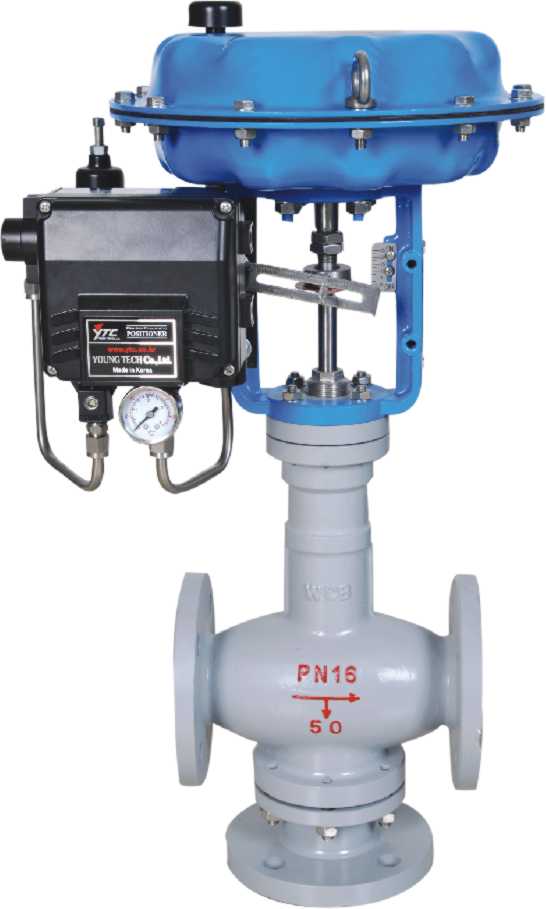
A 3-way globe control valve is usually selected for modulating control. It uses linear motion and shaped trim to control how much flow goes through each path. This design is common in HVAC coils, heat exchangers and process temperature control loops.
| Comparison factor | 3-way ball valve | 3-way globe control valve |
|---|---|---|
| Motion | Quarter-turn rotary | Linear stem movement |
| Best use | Switching and routing | Modulating control |
| Control accuracy | Basic to moderate | Better for continuous control |
| Shutoff | Usually good | Depends on trim and leakage class |
| Flow capacity | High for size | Lower, but more controllable |
| Actuation | Manual, pneumatic, electric | Pneumatic or electric actuator |
| Common service | Utility switching, tank selection, bypass | Temperature control, mixing, diverting |
For simple on/off flow selection, choose a 3-way ball valve. For continuous temperature or flow control, choose a 3-way globe control valve or another valve specifically sized for modulation.
Common Port Arrangements
A 3-way valve should never be selected only by name. The port arrangement must match the piping and control logic.
- Which port is the common port?
- Is the valve designed for mixing or diverting?
- Does the valve have an L-port or T-port internal passage?
- Is the operation 90 degrees or 180 degrees?
- Are there two positions, three positions or more?
- Can all ports be closed?
- Can all ports be open at the same time?
- Is flow allowed in both directions?
For ball valves, the manufacturer should provide a flow diagram. For control valves, the datasheet should show port labels, flow direction and actuator fail position.
Manual, Pneumatic and Motorized 3-Way Valves
A manual 3-way valve uses a handle, lever or handwheel. It is simple and useful when the operator changes the flow path occasionally.
A pneumatic 3-way valve uses a pneumatic actuator. It is common in process plants with instrument air, especially when fast switching or fail-safe action is needed.
A motorized 3-way valve uses an electric actuator. It is common in HVAC, water systems, utility lines and remote locations where compressed air is not available. Motorized 3-way valves may be on/off or modulating depending on the actuator.
When choosing actuation, confirm:
- Available air or power supply
- Required operating speed
- On/off or modulating control
- Fail position
- Feedback signal
- Manual override requirement
- Enclosure or hazardous-area rating
Materials and Seat Selection
Material selection depends on the medium, pressure and temperature. Common body materials include brass, cast iron, ductile iron, carbon steel, stainless steel, duplex stainless steel, PVC, CPVC, PP and lined materials.
Seat and seal materials may include PTFE, RPTFE, PEEK, EPDM, NBR, FKM, graphite or metal. Each material has limits for temperature, pressure and chemical compatibility.
For steam, high-temperature oil, corrosive chemicals, slurry or abrasive media, do not assume a standard soft-seat 3-way valve is suitable. The valve body, trim, seat, stem seal, actuator and lining must all match the service.
How to Choose a 3-Way Valve
Start with the flow function. Decide whether the valve must mix, divert, switch or modulate. Then confirm the process data before selecting the valve construction and actuator.
Before ordering, confirm:
- Medium and chemical compatibility
- Minimum, normal and maximum flow rate
- Upstream and downstream pressure
- Operating and design temperature
- Required shutoff and leakage class
- Pressure drop and flow coefficient
- Pipe size and end connection
- Flow direction and port diagram
- Manual, pneumatic or electric operation
- Fail-open, fail-close or fail-in-place requirement
If the valve is for temperature control or continuous modulation, consider a 3-way globe control valve. If it is for switching between tanks, filters or flow paths, consider a 3-way ball valve with the correct L-port or T-port arrangement.
Common Mistakes with 3-Way Valves
- Confusing mixing and diverting service: a valve that works well in one flow direction may not be correct in the opposite direction.
- Skipping the port diagram: L-port and T-port valves can behave very differently even when the outside body looks similar.
- Assuming all ports can close: some designs always keep one flow path open, so separate isolation valves may be required.
- Ignoring actuator rotation: a 90-degree actuator may not provide all the flow positions required by a T-port valve.
- Using a standard ball valve for precise modulation: continuous control may require a characterized ball or globe control valve.
Final Thoughts
A 3-way valve is useful when a piping system needs to mix, divert or switch flow through three ports. It can simplify piping, reduce the number of valves and provide better control in temperature loops, bypass lines and process routing systems.
The most important step is defining the flow function. Mixing service combines two streams into one outlet. Diverting service sends one inlet to two possible outlets. L-port and T-port ball valves provide different switching patterns, while globe-type 3-way control valves are better for continuous modulation.
Frequently Asked Questions
What is a 3-way valve?
A 3-way valve is a valve with three ports. It is used to mix two flows into one, divert one flow to two possible outlets or switch flow between different paths.
What is the difference between a 2-way and 3-way valve?
A 2-way valve has one inlet and one outlet, so it mainly opens, closes or throttles one flow path. A 3-way valve has three ports and can mix, divert or switch flow between multiple paths.
What is mixing service in a 3-way valve?
Mixing service means two inlet flows enter the valve and leave through one common outlet. This is common in temperature control, blending and HVAC systems.
What is the difference between L-port and T-port 3-way valves?
An L-port valve usually connects the common port to one of two side ports. A T-port valve can connect more port combinations and may connect all three ports in some positions.
Can a 3-way valve be motorized?
Yes. A 3-way valve can be operated by an electric actuator for on/off switching or modulating control. The actuator must match the required rotation angle, torque, voltage, control signal and feedback requirement.
Need Help Selecting a 3-Way Valve?
Share the medium, flow function, pressure, temperature, pipe size, port arrangement and actuator requirement. JIANENG Valve can help evaluate the valve and control package.
Discuss Your Application