L-port and T-port three way ball valves may look similar from the outside, but their internal passages create different flow paths. Selecting the correct port pattern is essential for safe switching, mixing, diverting and isolation.
An L-port three way valve mainly switches flow between two paths. A T-port valve provides more combinations and may connect all three ports in one position. The required flow diagram, actuator rotation and shutoff behavior should be defined before the valve is ordered.
Quick Answer: L-Port vs T-Port
Choose L-port
Use an L-port when the system must select one of two outlets or one of two sources, with one main flow path active at a time.
Choose T-port
Use a T-port when the system needs mixing, bypass, flushing, distribution or multiple port combinations.
- An L-port normally connects two ports at a time.
- A T-port may connect two ports or all three ports.
- L-port is commonly used for flow selection and diverting.
- T-port is commonly used for mixing and multi-path routing.
- The actuator stops and rotation must match the required flow diagram.
L-Port vs T-Port at a Glance
| Comparison factor | L-port three way valve | T-port three way valve |
|---|---|---|
| Internal bore | L-shaped passage | T-shaped passage |
| Main function | Flow selection or diverting | Mixing, diverting or multi-path routing |
| Typical connection | Two ports connected at one time | Two or three ports can be connected |
| Common use | Select tank A or B; send flow left or right | Mix flows, split flow, bypass or connect all ports |
| Shutoff behavior | Depends on pattern and stop position | Depends on pattern and stop position |
| Actuator rotation | Often 90 degrees | Often 90 or 180 degrees |
| Best fit | Simple either-or switching | Applications needing several flow states |
What Is a Three Way Valve?
A three way valve has three connection ports instead of two. A ball, plug or control trim inside the body determines which ports are connected. Moving that internal element changes the route taken by the fluid.
Three way valves are used for tank selection, filter switching, pump and heat-exchanger bypasses, HVAC loops, chemical blending, sampling systems, CIP skids and utility routing. In ball valve designs, the internal L-port or T-port shape is the key difference.
What Is an L-Port Three Way Valve?
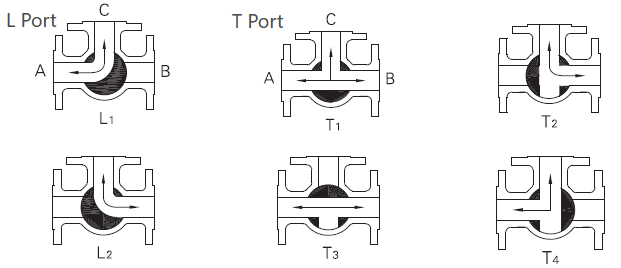
An L-port valve has an L-shaped passage through its ball. The passage usually connects two ports at a time. As the ball rotates, the common port changes its connection from one side port to the other.
This pattern is useful when the process needs a simple either-or choice:
- Divert flow to line A or line B
- Select tank 1 or tank 2
- Switch between two filters or pumps
- Send flow to the process or drain
- Change flow direction in a utility system
An L-port does not automatically guarantee a center-off position. Some valve and actuator combinations can block all ports, while others only switch between two open paths. Confirm the actual flow diagram.
What Is a T-Port Three Way Valve?
A T-port valve has a T-shaped passage through its ball. It can provide more port combinations than an L-port. Depending on ball position, the valve may connect one port to another, connect the common port to two side ports or connect all three ports.
Typical T-port applications include:
- Mixing two flows into one outlet
- Diverting one flow to two outlets
- Bypass and recirculation systems
- Connecting multiple ports during flushing
- Utility manifolds and process routing
- Systems that keep a common port open in several positions
The extra flexibility also creates risk. Incorrect actuator stops can connect fluids or lines that should remain isolated.
Flow Path Difference
An L-port creates an elbow-shaped route. Flow enters one port and turns 90 degrees to another, so the design is commonly used for one-path-at-a-time selection.
A T-port creates a tee-shaped route. Depending on its position, it can provide straight-through flow, side flow or a connection among all three ports. Manufacturer flow diagrams can differ, so do not assume every L-port or T-port valve has identical positions.
90-Degree vs 180-Degree Operation
Many quarter-turn actuators rotate 90 degrees. This is sufficient for common L-port switching and some T-port applications. Other systems require 180-degree rotation so the valve can reach three distinct flow states.
For an automated three way valve, confirm:
- Required number of operating positions
- Rotation angle and position-stop settings
- Open and closed indication
- Intermediate-position feedback
- Fail position and manual override position
A valve that needs three positions may require a 180-degree actuator or special controls. A standard two-position actuator may not deliver the required flow path.
Mixing and Diverting
Both port patterns can be used for diverting, but they behave differently. An L-port normally sends one inlet to one of two outlets and is a good choice when only one outlet should be active. A T-port can send flow to one or both outlets in some positions.
For mixing, a T-port is normally more suitable because two inlets can combine through a common outlet. If the process needs accurate proportional mixing or temperature control, a three way globe control valve may be more suitable than a standard T-port ball valve.
Shutoff and Isolation Behavior
Three way valves do not all provide the same shutoff behavior. Some L-port valves have an off position where all ports are blocked; others always leave one path connected. Some T-port valves intentionally connect all three ports in one position.
Before ordering, confirm whether any position closes all ports, whether ports remain connected during rotation, whether leakage can pass between closed ports and whether separate block valves are required. For critical isolation, do not rely on a three way valve unless its shutoff function is clearly documented.
Manual, Pneumatic and Electric Operation
Manual operation suits occasional switching, provided the handle clearly indicates the connected ports. Pneumatic actuators support fast operation and spring-return fail-safe action in plants with compressed air. Electric actuators suit HVAC, water treatment and remote utility systems where instrument air is unavailable.
For any automated three way valve, the actuator and valve flow diagrams must be matched. See our guide to pneumatic valves vs electric valves for additional actuator-selection considerations.
Material and Seat Selection
The port pattern determines the flow path, but body, seat and seal materials determine whether the valve can survive the service. Common body materials include brass, carbon steel, stainless steel, PVC, CPVC, PP and lined materials. Common seats and seals include PTFE, RPTFE, PEEK, EPDM, NBR, FKM and graphite.
Pressure, temperature, chemical compatibility, leakage requirements and the presence of abrasive solids must all be checked. Standard soft-seated three way ball valves may not suit steam, high-temperature oil, aggressive chemicals or slurry.
Which Three Way Valve Should You Choose?
Choose an L-port when
- One of two outlets or inlets must be selected
- Only one flow path should be open
- The process needs simple diverting
- The control logic has two main positions
Choose a T-port when
- The system needs mixing or split flow
- All three ports must open in one position
- Bypass or flushing paths are required
- Several flow combinations are needed
For available constructions, see JIANENG's three way ball valve and ball valve range. If continuous modulation is required, compare the control-valve option before finalizing the specification.
Application Examples
| Application | Better choice | Reason |
|---|---|---|
| Select tank A or tank B | L-port | One source is selected at a time |
| Process or bypass routing | L-port or T-port | Depends on whether both paths may open |
| Mix hot and cold water | T-port or 3-way globe valve | Two inlets combine into one outlet |
| HVAC coil temperature control | 3-way globe control valve | Better modulating control |
| Flush all connected lines | T-port | Can connect multiple ports |
| Switch between two filters | L-port | Simple either-or selection |
| Critical isolation of two fluids | Often not T-port | Avoid accidental cross-connection |
Common Selection Mistakes
- Ordering without a flow diagram: the words L-port and T-port do not define every possible stop position.
- Using a T-port where fluids must never mix: some positions can connect all three ports.
- Selecting the wrong actuator: three-position service may need 180-degree rotation or special stops.
- Assuming a ball valve provides precise modulation: accurate proportional control may require characterized trim or a globe control valve.
- Ignoring transition flow paths: ports may remain connected while the ball rotates between commanded positions.
Related Three Way Valve Resources
- What Is a 3-Way Valve? Mixing and Diverting Explained
- JIANENG Three Way Ball Valves
- JIANENG Three Way Control Valves
- Discuss a Three Way Valve Application
Final Thoughts
The essential difference is the internal flow path. An L-port valve is best for selecting or diverting between two paths. A T-port valve is more flexible and can support mixing, bypass and multi-port routing.
Define every required flow position before selecting the valve. Then match the port diagram, body and seat materials, pressure and temperature ratings, actuator rotation, control signal and fail position to the application.
Frequently Asked Questions
What is an L-port three way valve?
It has an L-shaped passage through the ball. It usually connects two ports at a time and is commonly used to select one of two flow paths.
What is a T-port three way valve?
It has a T-shaped passage through the ball. It can provide more port combinations and may connect all three ports in some positions.
Which is better, L-port or T-port?
Neither is universally better. L-port is simpler for flow selection and diverting. T-port is better for mixing, bypass, flushing and applications that need several flow combinations.
Can a three way valve shut off all ports?
Some designs can, but others cannot. The result depends on the ball pattern, valve construction and actuator stops, so the flow diagram must be checked.
Can a T-port valve be used for mixing?
Yes. A T-port can combine two inlet streams through one outlet. For accurate proportional control, a three way globe control valve may be a better choice.
What information is needed to order a three way valve?
Provide the medium, pressure, temperature, pipe size, connection, materials, port diagram, required positions, actuator type, power or air supply, control signal and fail position.
Need Help Selecting an L-Port or T-Port Valve?
Share the required flow positions, medium, pressure, temperature, pipe size and actuator requirements. JIANENG Valve can help review the three way valve and automation package.
Discuss Your Application