Needle valve types differ in stem tip, body pattern, bonnet, packing, material, connection and actuation. All use a slender stem moving into a small seat to adjust flow gradually, but they do not offer identical control resolution or shutoff performance.
Needle valves are common in instrument lines, sampling systems, pressure gauges, hydraulic equipment, gas panels and low-flow process connections. Selection should account for pressure, temperature, fluid cleanliness, viscosity, required Cv, adjustment resolution and whether positive shutoff is required.
Quick Answer: What Are the Main Needle Valve Types?
The main types include straight and angle body patterns; integral, union and screwed bonnets; regulating, fine-metering, soft-seat, hard-seat and non-rotating stems; multiport gauge valves; and manual or actuated versions. Choose by function and published flow data—not port size alone.
How a Needle Valve Works
Turning the handle advances a threaded stem toward a small orifice. The long tapered tip changes the annular flow area gradually over multiple turns, allowing finer manual adjustment than a quarter-turn ball valve.
The flow path is often globe shaped, so fluid changes direction through the seat. This produces relatively high pressure drop and a small Cv. Needle valves are therefore suited to low-flow regulation and instrument isolation, not large main-line flow.
A needle valve is not automatically a control valve. Manual adjustment holds an approximate setting. Closed-loop control requires a suitable actuator, sensor and controller, and accurate modulation may call for a purpose-designed metering or industrial control valve.
Stem pitch, taper angle, seat diameter and handle turns determine resolution. Many turns do not guarantee repeatability if backlash, packing friction or an oversized orifice dominates.
Needle Valve Types by Body Pattern
Straight-pattern needle valve
Inlet and outlet are in line, while the internal path turns through the seat. Straight bodies suit instrument tubing and panels where piping approaches from opposite directions.
Angle-pattern needle valve
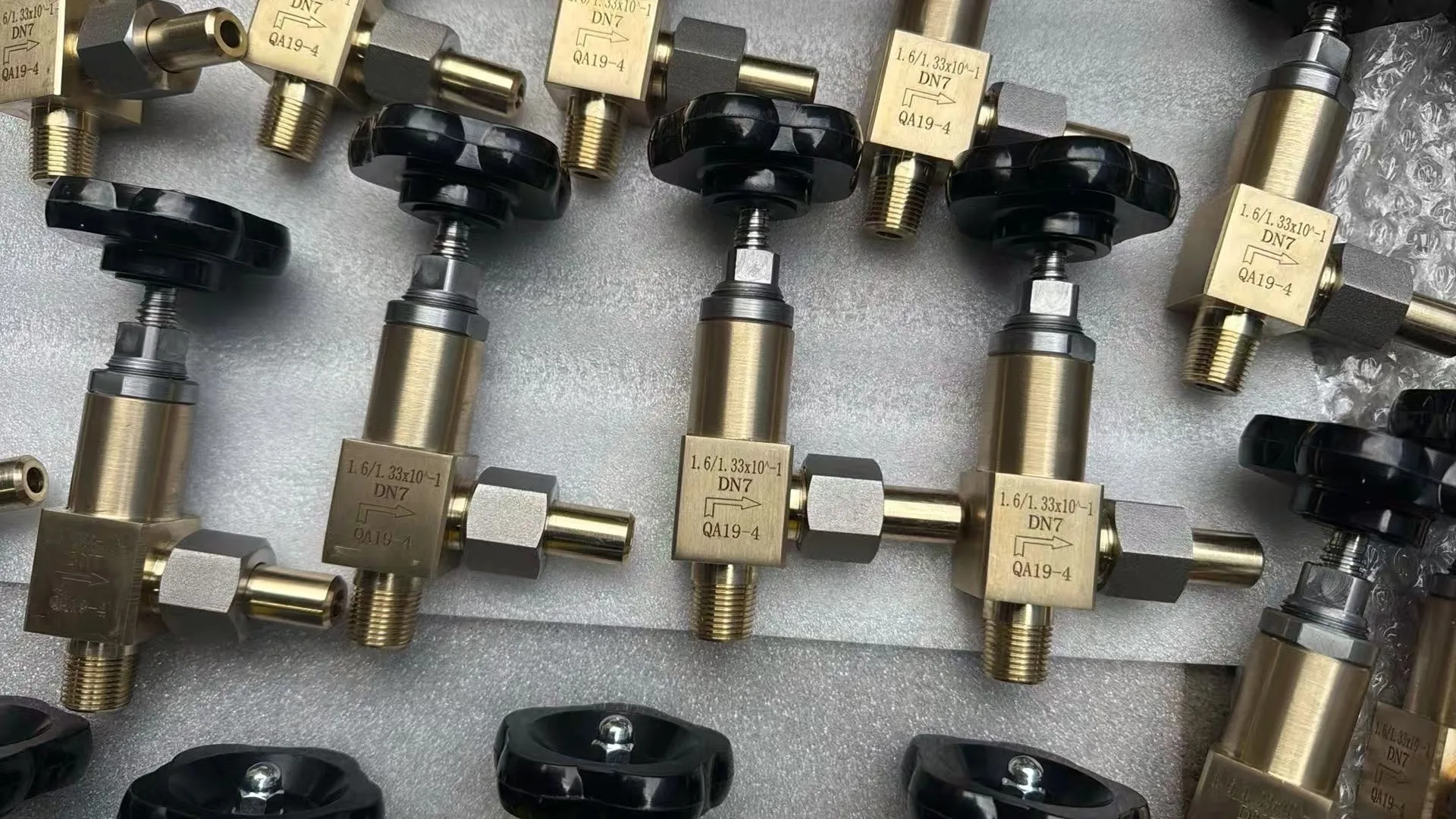
The outlet is 90 degrees from the inlet. This can replace a separate elbow and reduce fittings in gauge or sampling connections. Confirm the preferred inlet because pressure direction may affect stem loading and shutoff.
Multiport needle valve
Three-way and multiport bodies combine isolation, equalizing, venting or calibration paths. Review the port diagram; a three-way needle valve should not be assumed to behave like an L-port ball valve.
Gauge, root and block-and-bleed valves
Gauge valves connect pressure instruments to process piping and may include bleed, vent or test connections. Root valves at the process takeoff can require higher pressure, temperature or emissions capability than downstream panel valves. A block-and-bleed assembly combines functions, but the name alone does not prove double isolation—specify the seats, pressure sources and bleed location.
Stem and Seat Designs
| Design | Primary benefit | Selection caution |
|---|---|---|
| Regulating stem | Balances adjustment and shutoff | Confirm the published leakage and flow data |
| Fine-metering stem | Smaller area change per turn | Some designs are not intended for shutoff |
| Soft seat | Can improve closure and reduce seat damage | Temperature, chemical compatibility and extrusion limit service |
| Hard seat | Supports higher-temperature or demanding fluids | Metal seating may have different leakage performance |
| Non-rotating stem | Reduces rubbing during final closure | Choose from pressure, cleanliness, cycle and maintenance needs |
| Replaceable seat | Supports planned maintenance | Access and repair method must suit the installation |
Swagelok's valve-selection guidance distinguishes needle valves from fine-metering designs and notes that some fine-metering valves are not intended for shutoff. Never force a delicate stem closed; excessive handle torque can damage the small seating surfaces.
Bonnet, Packing and Actuation
An integral bonnet reduces body joints. A union bonnet allows assembly access, while a screwed bonnet is compact and common in simpler designs. Bonnet construction affects pressure-boundary integrity, maintenance and possible leakage paths.
Packing seals the moving stem. PTFE-based packing is common at moderate temperature; graphite and engineered materials serve other ranges. Packing selection also affects friction, emissions and adjustment feel. A backseat, where provided, is not a substitute for safe depressurization before maintenance.
Handles include T-bars, round knobs, anti-tamper caps and vernier or micrometer scales. A scale improves setting repeatability only when the flow-pressure relationship is known. Pneumatic or electric actuation is possible, but fine stems require appropriate thrust and travel resolution.
Common Needle Valve Applications
Pressure gauge isolation
The valve isolates an instrument and can soften rapid pressurization when opened gradually. It must not be treated as the gauge's only overpressure protection.
Sampling and gas panels
Fine adjustment can control sample, purge, carrier or calibration-gas flow. Check dead volume, purge needs, cleanliness, toxicity, emissions, material compatibility and whether the fluid can crystallize or plug the small orifice.
Hydraulic and chemical-injection systems
Needle valves can adjust pilot or bypass flow and may influence actuator speed. High viscosity, contamination, pulsating pumps, crystallization and large differential pressure can change flow or damage trim, so use application-specific ratings.
Steam and high temperature
Instrument isolation may use metal-seated designs with suitable packing. Verify pressure-temperature rating, flow direction and thermal expansion; general-purpose soft-seat valves may not be suitable.
Needle Valve vs Other Valve Types
| Valve | Main strength | Main limitation |
|---|---|---|
| Needle | Fine low-flow adjustment | High pressure drop and small capacity |
| Ball | Fast isolation and high capacity | Limited fine control |
| Globe | Broader modulating service | Larger and heavier |
| Metering | Very fine repeatable adjustment | May not provide shutoff |
| Check | Prevents reverse flow | Does not manually regulate |
For broader throttling duties, compare the alternatives in our throttling valve selection guide. For an automatically controlled process, also review the operating cases and Cv workflow in Control Valve Sizing.
How to Select a Needle Valve
- Define the function. State whether the valve regulates, isolates, vents, drains, samples or equalizes. If it must regulate and shut off, verify both ratings.
- Define the fluid. Provide the fluid, concentration, phase, viscosity, solids, toxicity and cleanliness. Small passages are sensitive to particles and deposits.
- Define pressure and temperature. State maximum inlet pressure, outlet pressure, differential pressure and temperature. Use ratings for the actual body, seat and packing combination.
- Define the flow range. Give minimum, normal and maximum flow with units. Request Cv or flow-versus-turn curves at the relevant stem positions.
- Select pattern and stem. Choose straight, angle or multiport body, then regulating, fine, soft-seat, hard-seat or non-rotating stem. Confirm preferred flow direction.
- Select materials and connections. Check body, stem, seat, packing and lubricant compatibility. Define NPT, BSP, compression, welded or flanged connections precisely.
- Review operation and safety. Specify handle, lock, anti-tamper feature or actuator. Consider accidental closure, trapped pressure, safe vent destination and access.
The verified Parker needle-valve catalogue shows why bonnet, stem, seal, body pattern, material and connection must be treated as separate ordering parameters.
Stem Geometry and Flow Repeatability
The word “needle” does not define one universal taper. A long, shallow taper changes the annular opening gradually and supports fine adjustment at low flow. A shorter or blunter taper opens capacity faster but offers less resolution per turn. Seat diameter, stem travel, thread pitch and port geometry also affect the curve.
For repeatable settings, request flow data against turns from closed for the exact stem and fluid basis. A numbered knob or vernier scale can return an operator to an approximate position, but it is not a calibrated flowmeter. Supply pressure, outlet pressure, temperature, viscosity and gas compressibility can change delivered flow at the same setting.
Packing friction and thread condition can introduce hysteresis: the flow reached while opening may differ from the flow reached while closing to the same scale mark. If the process needs accurate closed-loop regulation, choose suitable control equipment rather than expecting manual adjustment to provide control-system accuracy.
Installation and Commissioning
- Flush tubing before connection so debris, sealant or scale cannot enter the small seat.
- Apply thread sealant only as specified and keep it away from the first threads.
- Support tubing and use the valve's wrench flats rather than twisting through the handle or bonnet.
- Open gradually at startup and confirm the preferred flow direction.
- Approach the setting from the same direction when repeatability matters.
- Record fluid, pressures, temperature, measured flow and handle position at the accepted setting.
- Check external leakage, unstable flow and unusual stem resistance after initial cycles.
Common Selection Mistakes
- Selecting by port size without Cv or a flow curve
- Expecting every fine-metering valve to provide positive shutoff
- Using a needle valve for high-volume pipeline flow
- Ignoring flow direction and pressure-assisted closure
- Installing dirty service without filtration or flushing
- Mixing NPT and BSP threads
- Applying excessive handle torque at shutoff
- Treating handle turns as a universal flow percentage
- Omitting packing and lubricant compatibility
Needle Valve RFQ Checklist
| Category | Information to provide |
|---|---|
| Function | Regulate, isolate, vent, sample or equalize |
| Fluid | Composition, phase, viscosity, solids and cleanliness |
| Conditions | Inlet pressure, outlet pressure, temperature and flow range |
| Body | Straight, angle, multiport or manifold |
| Stem | Regulating, fine, soft, hard or non-rotating |
| Materials | Body, stem, seat, packing, seals and lubricant |
| Connection | Type, size and thread or tube standard |
| Operation | Handle, lock, scale, anti-tamper feature or actuator |
| Performance | Cv curve, allowable leakage, testing and documentation |
Frequently Asked Questions
What is the difference between a needle valve and a metering valve?
Needle valve is a broad term for a tapered-stem valve used for low-flow adjustment and often shutoff. A fine-metering valve emphasizes very small, repeatable changes; some metering designs are not rated for tight shutoff.
Can a needle valve stop flow completely?
Many general-purpose designs regulate and shut off, but not all do. Specify allowable leakage and confirm the stem and seat rating instead of forcing a delicate stem beyond the manufacturer's guidance.
Why are needle valves used for pressure gauges?
They provide gradual pressurization and isolation in a compact instrument connection. Slow opening can reduce sudden gauge loading, but the valve does not protect against sustained overpressure.
Can a needle valve control gas?
Yes, when pressure, temperature, material, cleanliness and leakage ratings suit the gas. Gas density changes with pressure, so use compressible-flow data. Toxic, flammable or high-purity gases may require special packing, cleaning and testing.
How is a needle valve sized?
Define the fluid, minimum, normal and maximum flow, inlet and outlet pressure and temperature. Use the manufacturer's Cv or flow-versus-turn curve for the selected stem and orifice, then confirm that normal flow falls in a controllable region.
Technical Sources
- Swagelok — Valve Selection Best Practices
- Swagelok — Needle Valve Selection Guide
- Parker Hannifin — Needle Valves Catalog 4110-NV
- Emerson — Control Valve Handbook
Sources verified August 10, 2026.
Prepare a Low-Flow Valve Inquiry
Share the fluid, pressure, temperature, minimum-to-maximum flow, connection and shutoff expectation. JIANENG Valve can help organize the specification and identify missing application data before quotation.
Discuss Your Application