
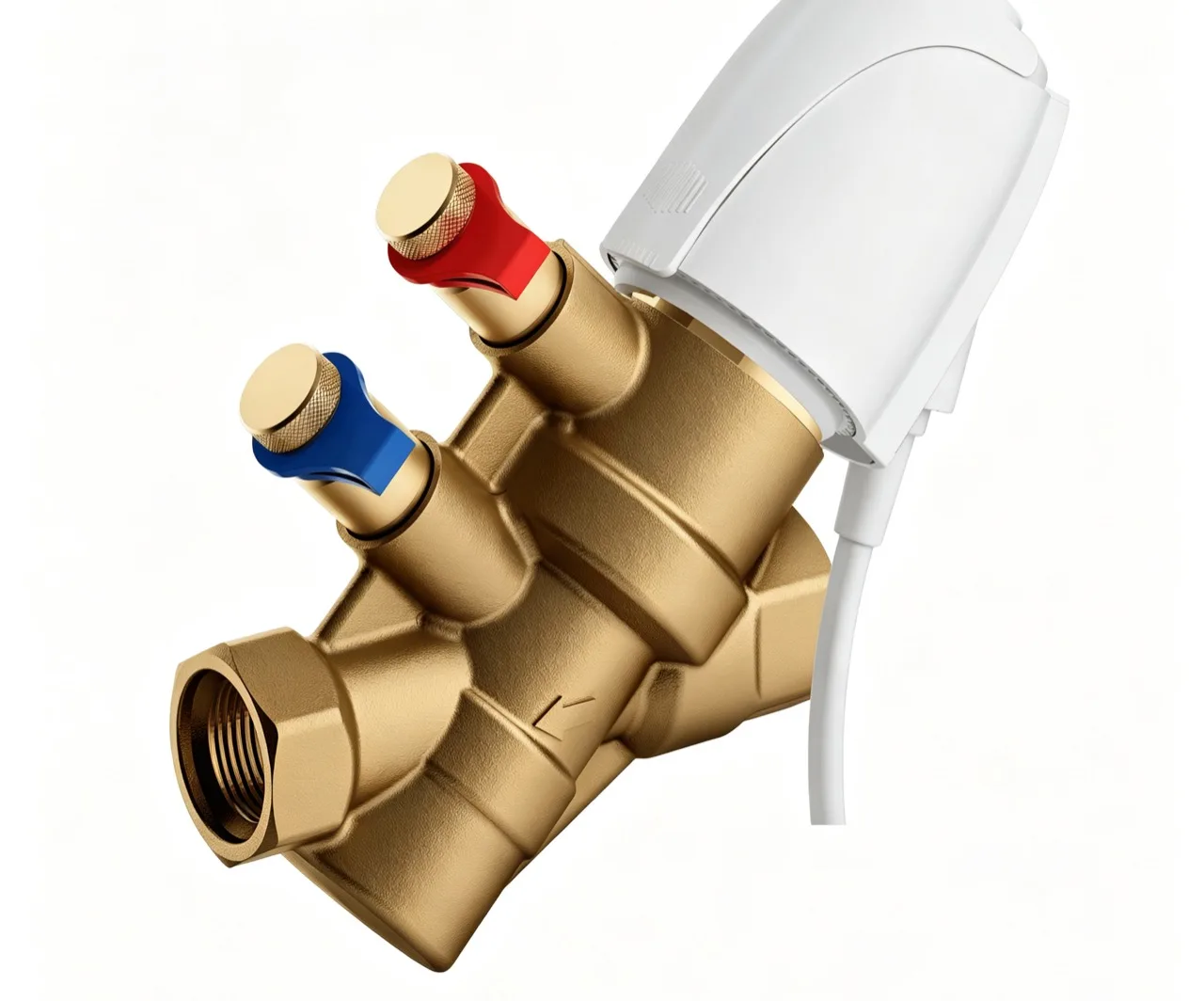
A pressure independent control valve (PICV) combines flow control and differential-pressure regulation so that system pressure changes have less effect on the commanded flow. In a variable-flow hydronic system, this can simplify balancing and help terminal units receive predictable flow within the valve's specified operating range.
The direct answer is that a PICV is only pressure independent when the available differential pressure stays between the product's minimum and maximum limits. Correct design flow, valve authority inside the assembly, actuator control, installation and commissioning still matter.
Key Takeaways
- A PICV normally combines a control valve, a differential-pressure regulator and a preset or electronic flow limit.
- The valve must have enough differential pressure to regulate, but not more than its maximum allowable value.
- Design flow replaces traditional Cv-only selection for many PICV products, yet pipe size should not be used as the sole selection criterion.
- PICVs can reduce dependence on separate balancing valves, but commissioning must still verify flow, direction, air removal and actuator operation.
- Mechanical PICVs, electronic PICVs and energy valves provide different levels of measurement, communication and control.
What Is a Pressure Independent Control Valve?
A pressure independent control valve is a two-way hydronic control assembly designed to deliver a defined flow response despite changing differential pressure in the distribution system. Depending on the product, it may use a mechanical diaphragm regulator, an electronic flow sensor and control algorithm, or a combination of pressure regulation and characterized valve geometry.
The valve is "independent" of system pressure only over a published control range. Below the minimum differential pressure, it cannot deliver the set flow. Above the maximum, noise, wear, control instability or component limits may become concerns. The selected datasheet therefore needs minimum differential pressure, maximum differential pressure and maximum controllable flow.
PICVs are common in chilled-water and heating-water networks serving air-handling units, fan-coil units, heat exchangers and other terminal equipment. The data center valve types guide shows how control valves and actuators fit cooling loops where uptime and thermal stability matter.
How a PICV Maintains Flow
Mechanical pressure regulation
In a mechanical PICV, a diaphragm and spring respond to the pressure difference across the control-valve section. When system differential pressure rises, the regulator reduces its opening; when pressure falls, it opens further. This keeps the pressure drop across the control element closer to its intended value, allowing valve position to correspond more consistently to flow.
The design flow is normally set with an adjustment mechanism or selected product size. The actuator then modulates the control element between closed and the preset maximum. Product-specific flow curves, minimum pressure and adjustment procedures must be used; the principle does not create one universal sizing equation.
Electronic pressure-independent control
An electronic PICV may measure flow directly and drive the valve to match a command. Some devices also report flow, temperature, energy or diagnostic data through analog signals or building-automation protocols. These functions can support commissioning and monitoring, but they add requirements for sensor accuracy, wiring, software setup, communication mapping and long-term maintenance.
Why pressure independence helps
In a conventional pressure-dependent circuit, a control valve's flow changes when the pressure across it changes, even if the commanded position stays constant. Pumps changing speed, other branches opening or closing and differential-pressure reset can all alter that pressure. A PICV compensates within its operating range, reducing interaction between branches.
PICV vs Conventional Control Valve
| Decision factor | Conventional two-way control valve | Pressure independent control valve |
|---|---|---|
| Primary selection input | Required Cv/Kv and available pressure drop | Design flow and PICV differential-pressure range |
| Balancing | Often needs separate balancing strategy | Flow limiting is integrated in the assembly |
| Response to pressure change | Flow changes unless the loop compensates | Regulator or electronic control compensates within limits |
| Commissioning | Verify valve, balancing device and circuit flow | Set design flow and verify PICV operation |
| Diagnostics | Depends on actuator and external sensors | Electronic versions may report flow and other data |
| Main risk | Poor valve authority or incorrect balancing | Insufficient available differential pressure or wrong preset |
A conventional valve can still be the right choice for a stable system, process duty, larger size, unusual fluid or project standard. A PICV is not a general replacement for every industrial control valve. Review control valve types used in industrial applications when the service extends beyond closed hydronic loops.
Where PICVs Are Used
Typical applications include:
- Chilled-water coils in air-handling units
- Fan-coil units and zone branches
- Heating-water coils
- Heat exchangers and energy-transfer stations
- Data center cooling distribution
- Variable-flow building networks
- Retrofit circuits affected by branch interaction
The fluid must be compatible with the valve and regulator materials. Water-glycol concentration, water quality, suspended solids, oxygen ingress and treatment chemicals can affect seals, diaphragms, sensors and strainers. State the fluid and concentration rather than writing only "water."
For a terminal coil, the design should also confirm coil flow, required heat transfer, control sequence, pump strategy and available differential pressure at the hydraulically remote circuit. Installing a PICV does not correct an undersized pump, blocked strainer, air-bound coil or incorrect sensor location.
How to Select a PICV
- Establish design and minimum flow. Use the coil or equipment design data to determine required flow. If the valve must control below the design point, check the published controllable flow range, turndown and actuator resolution. Do not automatically choose the same nominal size as the pipe.
- Calculate the available differential pressure. At maximum design flow, confirm that the remote circuit has at least the PICV's minimum required pressure after pipe, coil, strainer and accessory losses. At high pump head or low system demand, confirm that the valve will not exceed its maximum differential pressure or noise limits.
- Check pressure, temperature and fluid. Verify nominal pressure rating, close-off pressure, fluid temperature, ambient temperature, glycol limit, material compatibility and water-quality requirements. Product ratings may differ between the valve body, regulator, flow sensor and actuator.
- Select the actuator and signal. Define on-off, floating or modulating control; voltage; signal range; fail behavior; run time; feedback; communication protocol and enclosure. A fast actuator is not automatically better: loop stability depends on sensor response, controller tuning, valve characteristic and equipment dynamics.
- Decide how flow will be verified. Mechanical PICVs may use pressure/temperature ports and product-specific charts or instruments. Electronic designs may provide a measured flow value, but independent verification can still be required by the project. State accuracy, calibration, reporting and acceptance requirements before purchase.
General control valve sizing remains useful for understanding pressure balance, operating cases and why nominal pipe size does not define valve capacity.
Installation and Commissioning
Install the valve in the marked flow direction and within the actuator orientation limits. Provide the straight pipe, strainer, flushing and access arrangements required by the manufacturer. Protect the actuator from condensate and ensure that insulation does not cover electronics, vents or service points.
Before commissioning, flush the system with control valves protected as required, remove air and clean strainers. Confirm the design-flow setting, actuator rotation, signal scaling, close-off and controller command. For an electronic device, verify units, network address, firmware or application settings and the mapping of flow and alarm points.
Commissioning should test more than maximum flow. Observe low, normal and design-load commands; pump-speed changes; adjacent branches opening and closing; and the remote circuit. Record the final preset, measured flow, differential pressure and control signal so that later maintenance has a baseline.
Pressure independence has limits. Outside the published minimum and maximum differential pressure, a PICV cannot deliver the promised behavior. Confirm the available pressure at the hydraulically remote circuit before selecting the product, and document the preset, measured flow and signal at commissioning.
Common PICV Mistakes
- Selecting from pipe size instead of design flow
- Ignoring the minimum differential pressure
- Allowing excessive differential pressure and noise at low system demand
- Setting the wrong maximum flow
- Installing the valve against the flow arrow
- Omitting flushing, air removal or strainer maintenance
- Treating electronic reported flow as verified without a commissioning method
- Using a PICV in an incompatible dirty, corrosive or open process fluid
- Failing to coordinate valve signal, controller output and actuator configuration
PICV Datasheet Checklist
- Heating or cooling medium and glycol concentration
- Design, minimum and maximum required flow
- Available minimum and maximum differential pressure
- Pipe size and connection
- Nominal pressure and fluid-temperature range
- Mechanical or electronic pressure-independent design
- Preset range and flow accuracy requirement
- Actuator voltage, signal, run time and fail behavior
- Analog feedback or BACnet, Modbus or other communication
- Flow-verification and commissioning method
- Strainer, P/T ports, insulation and access requirements
- Documentation, calibration and acceptance criteria
Frequently Asked Questions
Does a PICV need a balancing valve?
A PICV integrates flow limiting and pressure regulation, so a separate terminal balancing valve is often unnecessary. The complete system still needs hydraulic design, pump control and a commissioning method. Follow the project specification and product application guidance.
What happens if differential pressure is too low?
The regulator reaches its available opening and cannot maintain the preset flow. The branch becomes pressure starved, so actual flow falls below the command. Check the remote circuit, pump head, pipe losses, coil, strainer and valve minimum differential pressure.
Can a PICV be oversized?
Yes. A valve with a flow range far above the design requirement may have an unsuitable preset range or poor resolution at low load. Select the smallest product whose controllable range, pressure limits, connection and close-off capability cover the application.
Is a PICV the same as an automatic balancing valve?
Not exactly. An automatic flow limiter maintains a preset maximum flow, while a PICV also includes a control function that modulates flow from closed to the set maximum. Product terminology varies, so compare internal function and control behavior rather than labels alone.
Conclusion
A pressure independent control valve can make variable-flow hydronic systems easier to balance and less sensitive to branch pressure changes. Its performance depends on design flow, differential-pressure range, fluid compatibility, actuator control, installation and commissioning.
For a PICV or hydronic control valve inquiry, share the equipment flow, minimum and maximum differential pressure, fluid, temperature, pipe connection, actuator signal and commissioning requirement. Jianeng Valve can help organize the application data and determine whether a pressure-independent or conventional control solution is the better fit.
Technical Sources
- Belimo — Energy Valve Application Guide
- Belimo — Electronic Valve Application Guide
- Belimo — ZoneTight Pressure Independent Zone Valve Technical Documentation
Sources verified August 28, 2026.
Need Help Specifying a Pressure Independent Control Valve?
Share the equipment flow, available differential pressure, fluid, temperature, pipe connection, actuator signal and commissioning requirement. JIANENG Valve can help determine whether a PICV or a conventional control valve is the better fit and prepare a technically comparable quotation.
Discuss Your Application